
AI and IoT Supporting Modern Trailer Yard Operations
Trailer yards are dynamic operating environments where trucks, trailers, yard tractors, carriers, dock personnel, and warehouse teams continuously interact. Every inbound shipment, outbound load, trailer relocation, and gate transaction influences transportation schedules, warehouse productivity, and customer delivery performance.
Traditional yard management often depends on manual inspections, paper gate logs, radio communication, and periodic yard checks. As trailer volumes increase, these methods make it difficult to maintain accurate trailer locations, verify driver credentials, coordinate dock assignments, and monitor shipment progression.
AI and IoT addresses these operational challenges by combining artificial intelligence with connected industrial systems, identification technologies, computer vision, machine learning, Edge AI, and wireless communication technologies such as RFID, Bluetooth® Low Energy (BLE), GPS, and cellular communications. Rather than focusing on sensing applications, the solution emphasizes identification, authentication, and location awareness across every stage of trailer yard operations.
Yard Management AI develops enterprise AI software that transforms operational events into actionable information for logistics managers, transportation planners, warehouse supervisors, gate operators, and security teams. The software helps organizations reduce manual work while improving operational consistency across trailer yards of every size.
Common deployment environments include:
- Retail distribution centers
- Manufacturing shipping yards
- Third-party logistics facilities
- Cross-dock terminals
- Container yards
- Intermodal freight facilities
- Cold chain distribution yards
- Fleet maintenance facilities
- Trailer storage compounds
- Regional logistics campuses
The objective is to ensure that every trailer, driver, gate event, and shipment remains identifiable, traceable, and operationally visible throughout its movement across the yard.
AIoT-Enabled Trailer Yard Operations Workflow
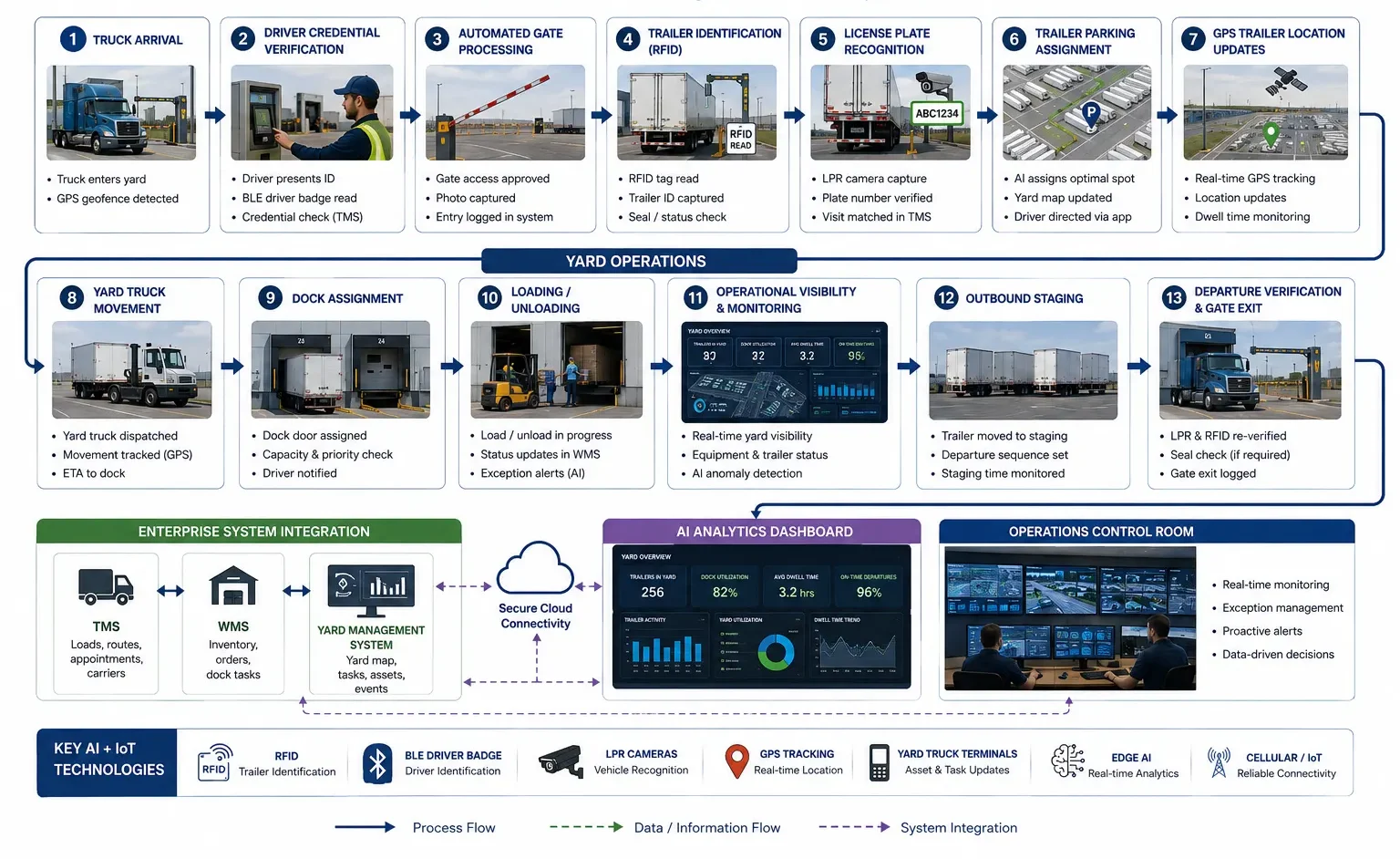
This enterprise workflow diagram illustrates how AI and IoT support modern trailer yard operations from truck arrival and driver verification through automated gate processing, trailer identification, parking assignment, GPS tracking, dock operations, loading, outbound staging, and departure. It also shows integration with TMS, WMS, AI analytics dashboards, and an operations control room to provide real-time visibility, operational coordination, and efficient trailer movement.
Gate Access AI
Gate operations establish the foundation for efficient trailer yard management. Every arriving truck, driver, trailer, contractor, and visitor must be authenticated before entering operational areas. Delays at entry points can quickly create congestion, increase carrier waiting times, and affect warehouse scheduling throughout the distribution center.
Gate Access AI applies machine learning, computer vision, Edge AI, RFID identification, BLE credentials, GPS awareness, and license plate recognition to automate verification activities while maintaining accurate operational records. The software supports high-volume logistics facilities where rapid processing and reliable identification are essential.
Instead of relying on manual paperwork or visual inspections, Gate Access AI helps verify authorized personnel, validate trailer assignments, document arrival events, and synchronize gate transactions with transportation and warehouse software.
Core operational capabilities include:
- Automated credential verification
- Driver identity validation
- Trailer identification
- Carrier authorization
- Visitor management
- Gate event recording
- Security auditing
- Arrival and departure documentation
These capabilities improve gate throughput while reducing administrative effort and strengthening operational consistency.
AI Gate Access Verification
Gate verification represents the first operational checkpoint within every trailer yard. Accurate identification at this stage helps prevent unauthorized access while ensuring that only scheduled drivers, approved carriers, and assigned trailers enter operational areas.
AI Gate Access Verification combines multiple identification methods to evaluate each arrival automatically. Computer vision compares license plates, RFID identifies trailers, BLE credentials authenticate personnel, and AI software validates operational information against transportation schedules.
The software can verify:
- Driver authorization
- Carrier information
- Trailer identification
- Scheduled appointments
- Vehicle registration
- Access permissions
- Gate transaction history
- Operational exceptions
By automating these activities, facilities reduce manual inspections and create a consistent verification process regardless of daily traffic volume.
Operational benefits include:
- Faster gate processing
- Reduced entry congestion
- Improved security controls
- Accurate arrival records
- Enhanced compliance documentation
- Better carrier coordination
- Reduced administrative workload
- Improved operational visibility
Automated Driver Check-In
Manual driver check-in frequently creates bottlenecks during peak arrival periods. Drivers often wait while paperwork is reviewed, appointments are confirmed, and gate personnel manually enter operational data.
Automated Driver Check-In accelerates this process by digitally validating driver information before or during arrival. AI software coordinates identity verification with appointment schedules and assigned trailers, reducing repetitive administrative tasks.
Typical workflow improvements include:
- Digital driver identification
- Appointment confirmation
- Carrier verification
- Trailer association
- Visitor registration
- Arrival timestamp recording
- Direction to assigned parking areas
- Immediate notification to transportation teams
The result is a more efficient arrival process that improves both carrier experience and yard productivity.
Yard Personnel Presence Detection
Large trailer yards include gate operators, yard jockeys, warehouse employees, maintenance personnel, contractors, inspectors, and transportation staff. Maintaining visibility of authorized personnel supports operational coordination and workplace safety without relying on manual attendance records.
AI and IoT identifies personnel through authorized credentials and location technologies, helping operations managers understand workforce presence across key operational zones.
Common applications include:
- Gatehouse staffing verification
- Authorized yard worker identification
- Contractor access validation
- Visitor movement records
- Maintenance crew coordination
- Restricted area authorization
- Shift activity reporting
- Operational workforce visibility
These capabilities improve coordination between transportation, warehouse, and security teams while supporting compliance with facility access policies.
Unauthorized Entry Detection
Trailer yards frequently contain valuable freight, transportation equipment, and operational assets. Preventing unauthorized access helps protect shipments while reducing operational risk.
Unauthorized Entry Detection continuously evaluates gate activity to identify unusual or unauthorized events such as:
- Unknown vehicles
- Invalid driver credentials
- Unauthorized trailer movements
- Restricted area access
- Unscheduled arrivals
- Invalid carrier identification
- Duplicate access attempts
- Operational anomalies
When unusual activities are detected, AI software immediately records the event and alerts designated operational personnel for further review.
Rather than replacing existing security procedures, Unauthorized Entry Detection strengthens operational awareness by providing continuous digital verification across gate operations.
Benefits of AI-Enabled Gate Operations
Modern gate operations influence every downstream logistics activity. Faster verification, accurate identification, and synchronized operational records help transportation planners, warehouse supervisors, and security teams make informed decisions throughout the day.
Organizations implementing AI-enabled gate operations often experience improvements such as:
- Reduced truck queue times
- Faster trailer processing
- Improved appointment accuracy
- Better carrier communication
- Consistent access verification
- Improved operational reporting
- Greater trailer visibility from arrival
- Better coordination with warehouse activities
These improvements establish a reliable operational foundation for trailer tracking, yard inventory management, and shipment progression discussed throughout the remainder of this page.
AI-Enabled Gate Access Workflow
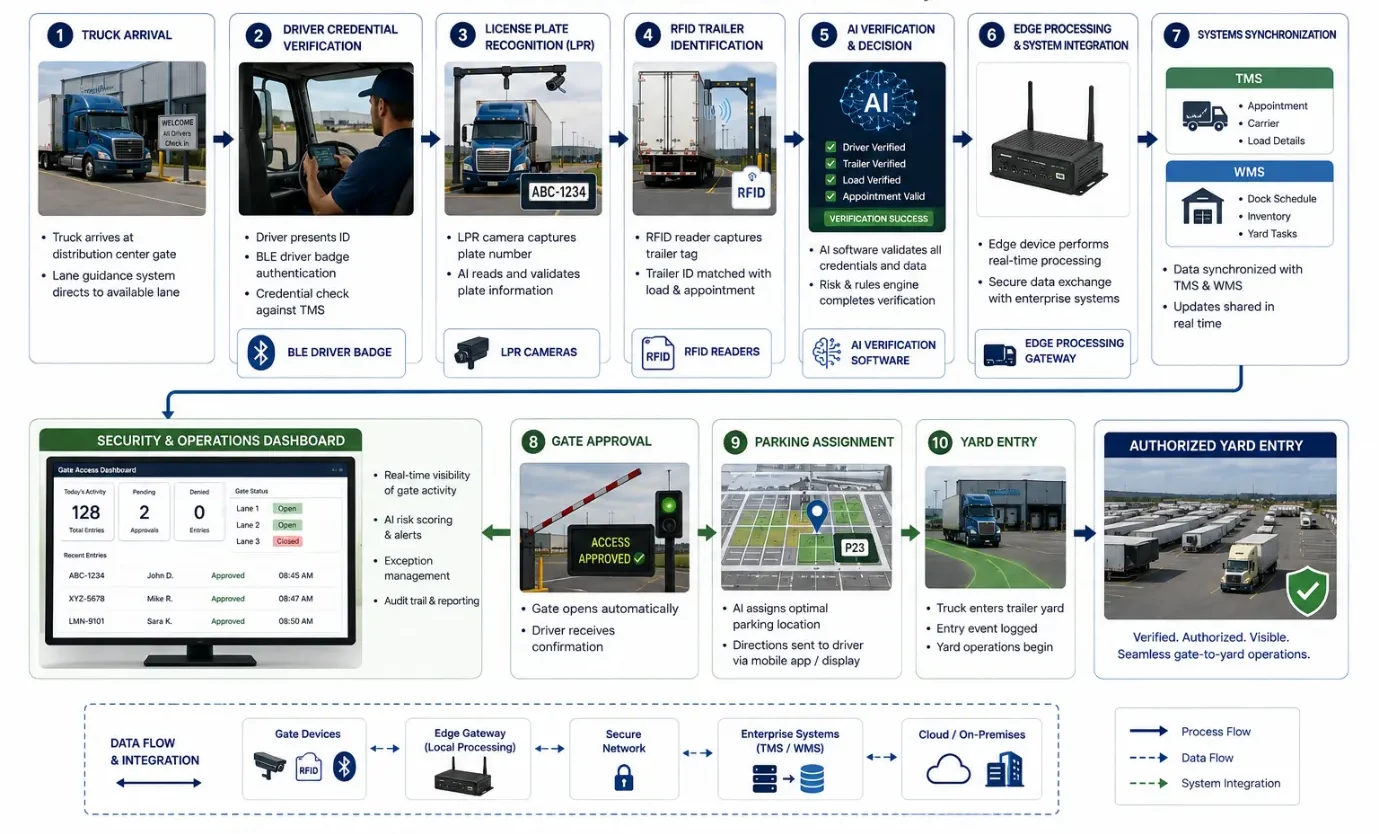
This workflow diagram illustrates how AI automates gate access for trailer yard operations by verifying drivers and trailers, integrating with TMS and WMS, approving entry, assigning parking locations, and providing real-time visibility through AI software and security dashboards.
Asset Visibility AI
Maintaining accurate visibility of trailers, containers, chassis, yard tractors, and other mobile assets is one of the most important responsibilities within trailer yard operations. Large distribution campuses may manage hundreds or even thousands of trailers across multiple parking zones, dock doors, staging areas, and outbound lanes. Manual yard checks often become time-consuming, while outdated inventory records can result in misplaced trailers, delayed shipments, inefficient dock utilization, and higher transportation costs.
Asset Visibility AI combines AI and IoT with identification and location technologies to maintain a continuously updated operational view of yard assets. By integrating RFID, GPS, BLE, license plate recognition, computer vision, and Edge AI, the software identifies trailer movements, updates locations, and records operational events without requiring manual yard inspections.
Rather than simply displaying trailer positions, Asset Visibility AI provides operational context that helps transportation planners, dispatchers, warehouse supervisors, and logistics managers understand how assets are being utilized throughout the yard.
Primary capabilities include:
- Continuous trailer location updates
- Automated yard inventory verification
- Trailer utilization analysis
- Yard occupancy reporting
- Dwell time monitoring
- Trailer movement history
- Parking zone optimization
- Fleet utilization reporting
These capabilities reduce trailer search time, improve operational planning, and provide reliable visibility across busy logistics facilities.
Real-Time Trailer Location AI
Finding the correct trailer at the right time is critical for maintaining efficient freight movement. Every unnecessary trailer search delays loading activities, increases yard truck travel, and affects transportation schedules.
Real-Time Trailer Location AI continuously associates each identified trailer with its latest verified yard position. Identification technologies work together to update trailer locations as equipment enters the facility, changes parking areas, moves to loading docks, or exits through outbound gates.
Operational visibility supports:
- Empty trailer management
- Loaded trailer identification
- Trailer pool coordination
- Drop-and-hook operations
- Dock door assignments
- Outbound staging
- Inbound receiving
- Cross-yard trailer relocation
Instead of relying on radio communication or manual searches, dispatchers and yard coordinators can immediately determine where a trailer is located and whether it is ready for its next operational task.
Operational advantages include:
- Faster trailer retrieval
- Reduced yard truck travel
- Improved dock scheduling
- Better trailer utilization
- Lower labor requirements
- Improved carrier turnaround
- Reduced operational delays
- More accurate transportation planning
Yard Asset Utilization Analytics
Visibility alone does not explain whether yard assets are being used efficiently. AI analyzes historical operational data to identify utilization trends, recurring bottlenecks, and opportunities for operational improvement.
Asset Utilization Analytics evaluates:
- Trailer occupancy
- Yard tractor activity
- Parking zone usage
- Dock assignments
- Carrier performance
- Trailer rotation
- Equipment availability
- Fleet utilization
Historical analysis allows logistics managers to determine:
- Which parking areas experience recurring congestion
- Which trailers remain idle for extended periods
- How efficiently yard tractors relocate trailers
- Which carriers generate the longest turnaround times
- Where operational resources should be reallocated
These operational insights support long-term planning while helping facilities improve daily execution.
Automated Yard Inventory Counts
Maintaining an accurate trailer inventory is essential for effective yard management. Traditional inventory methods often involve periodic physical inspections, which become increasingly difficult as yard size and trailer volume grow.
Automated Yard Inventory Counts use identification and location technologies to continuously validate trailer presence and operational status throughout the facility.
The software maintains current records of:
- Parked trailers
- Assigned trailers
- Available trailers
- Empty equipment
- Loaded equipment
- Reserved parking locations
- Carrier-owned trailers
- Customer-owned trailers
Inventory updates occur automatically as trailers move through operational workflows, reducing discrepancies between physical yard conditions and software records.
Operational benefits include:
- Improved inventory accuracy
- Reduced manual audits
- Faster trailer reconciliation
- Better shipment planning
- Improved dock coordination
- More reliable operational reporting
- Reduced misplaced assets
- Better trailer availability planning
Warehouse operations benefit because receiving and shipping personnel can confidently prepare dock activities using current trailer information.
Trailer Dwell Time Analytics
Trailer dwell time is one of the most closely monitored performance indicators within yard management. Extended dwell times reduce trailer availability, increase detention costs, delay outbound shipments, and contribute to yard congestion.
Trailer Dwell Time Analytics continuously evaluates how long each trailer remains in specific operational stages.
Common measurements include:
- Time at entry gate
- Parking duration
- Waiting for dock assignment
- Loading duration
- Unloading duration
- Outbound staging
- Total yard time
- Carrier turnaround
AI identifies operational patterns that contribute to unnecessary delays while helping logistics teams prioritize trailer movements based on urgency and operational impact.
Analytics dashboards support continuous improvement by highlighting:
- Recurring congestion periods
- Peak arrival windows
- Underutilized dock doors
- Carrier-specific delays
- Yard truck workload
- Operational exceptions
This information enables transportation managers to improve scheduling, allocate labor more effectively, and reduce avoidable trailer detention.
AI-Enabled Asset Visibility Workflow for Trailer Yard Operations
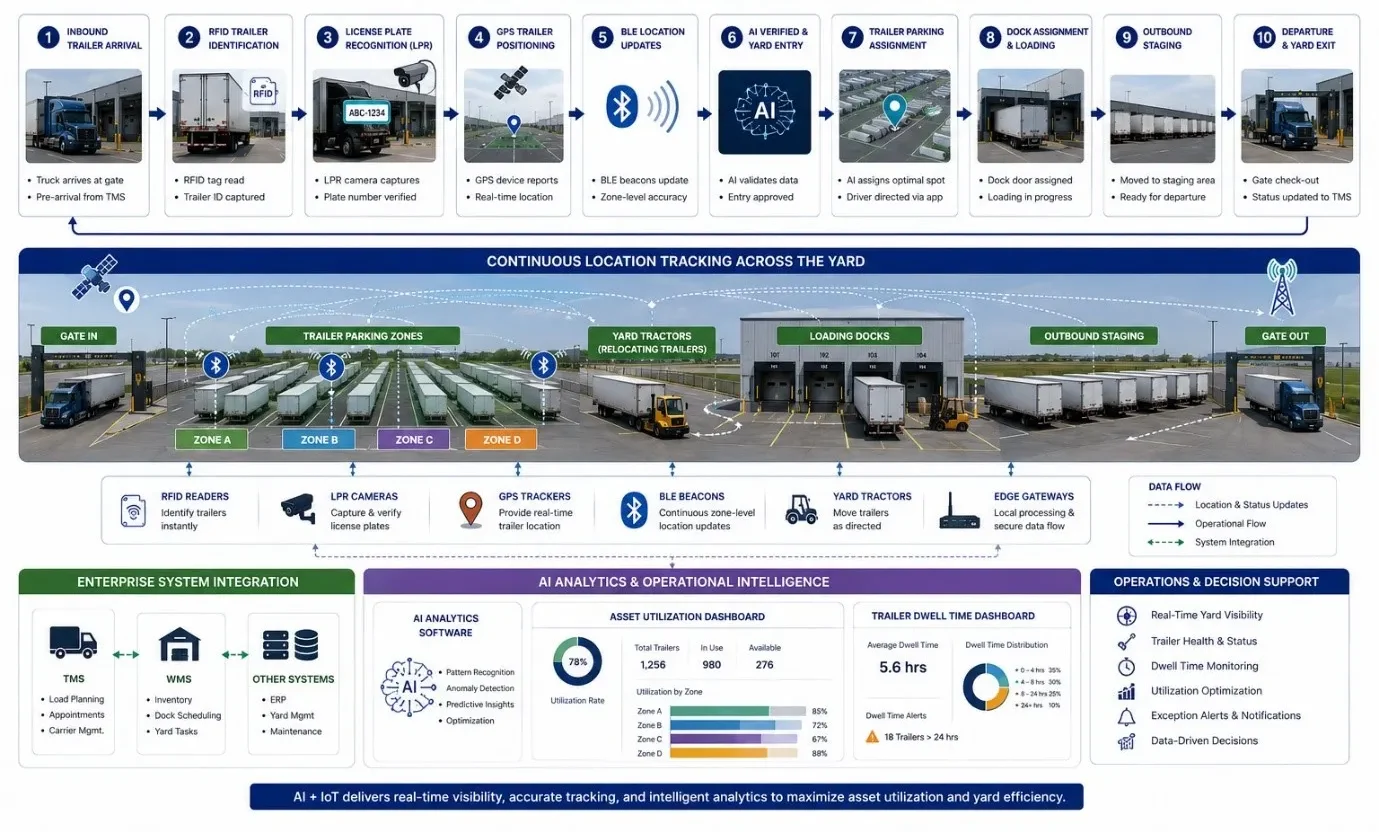
This enterprise workflow diagram illustrates how AI and IoT provide continuous trailer visibility throughout a distribution yard. It follows trailers from inbound arrival and identification through parking, relocation, dock operations, outbound staging, and departure while integrating RFID, GPS, BLE, license plate recognition, TMS, AI analytics, and operational dashboards to optimize asset utilization, reduce trailer dwell time, and improve yard efficiency.
How AI and IoT Reduces Detention and Demurrage Costs
Detention and demurrage charges represent significant operational expenses for organizations managing high trailer volumes. These costs typically result from delayed trailer processing, inefficient yard coordination, prolonged loading activities, and limited operational visibility.
AI and IoT helps logistics organizations reduce these expenses by improving identification, location accuracy, and operational coordination across the entire trailer lifecycle.
Rather than reacting to delays after they occur, operations teams gain continuous awareness of trailer movements, gate events, dock availability, and shipment progression. This visibility enables proactive decision-making before delays escalate into detention or demurrage charges.
Key operational improvements include:
- Faster gate entry and exit processing
- Immediate trailer location visibility
- Reduced trailer search times
- Improved dock scheduling
- Better yard truck dispatching
- Automated trailer inventory verification
- Earlier identification of operational bottlenecks
- More accurate carrier appointment coordination
AI also evaluates historical operational patterns to identify recurring sources of delay, including peak congestion periods, underutilized parking areas, prolonged trailer dwell times, and carrier-specific turnaround challenges.
For organizations operating cross-dock facilities, manufacturing shipping yards, retail distribution centers, or container terminals, these insights contribute to lower operating costs while improving overall transportation efficiency.
Load Traceability AI
Efficient trailer yard operations extend beyond knowing where trailers are located. Logistics teams also need visibility into shipment progression as freight moves from arrival through gate processing, yard staging, dock operations, loading or unloading, and final departure. Accurate load traceability helps transportation planners, warehouse supervisors, carriers, and distribution managers coordinate activities while reducing delays and improving shipment reliability.
Load Traceability AI combines AI and IoT with identification technologies, computer vision, machine learning, RFID, GPS, BLE, and cellular communications to maintain a digital record of operational events associated with each trailer and shipment. Rather than manually updating shipment status, the software automatically records operational milestones as trailers move through the yard.
The result is improved shipment visibility, better coordination between transportation and warehouse teams, and more reliable operational records for compliance and customer reporting.
Applications include:
- Inbound shipment processing
- Outbound shipment coordination
- Cross-dock operations
- Distribution center logistics
- Manufacturing shipping yards
- Container yard operations
- Cold chain logistics
- Multi-site freight movement
Load Status Progression Tracking
Every shipment passes through multiple operational stages before leaving a logistics facility. Delays at any stage can affect transportation schedules, dock utilization, carrier performance, and customer delivery commitments.
Load Status Progression Tracking records key operational milestones, including:
- Scheduled arrival
- Gate check-in
- Trailer verification
- Parking assignment
- Dock assignment
- Loading or unloading initiation
- Load completion
- Documentation verification
- Release authorization
- Gate departure
By automatically updating these milestones, operations teams gain a clear understanding of shipment readiness without relying on manual status updates or radio communication.
Operational benefits include:
- Improved shipment coordination
- Better dock scheduling
- Faster exception management
- Reduced communication delays
- Increased shipment visibility
- Improved carrier collaboration
- Accurate operational records
- Better transportation planning
Shipment Traceability Analytics
Modern logistics operations require more than current shipment status. Historical movement data helps organizations evaluate operational efficiency, identify recurring delays, and support compliance requirements.
Shipment Traceability Analytics creates a chronological record of trailer and shipment activity throughout the yard. Each operational event is associated with verified trailer identification, gate transactions, parking locations, dock assignments, and departure records.
Analytics can evaluate:
- Shipment processing duration
- Carrier turnaround performance
- Dock utilization trends
- Trailer movement frequency
- Cross-dock transfer efficiency
- Operational bottlenecks
- Peak workload periods
- Historical shipment movement
These insights help logistics managers improve scheduling, allocate operational resources, and refine yard workflows based on measurable performance data.
Reefer Load Condition Coordination
Distribution centers handling refrigerated food, beverages, pharmaceuticals, biotechnology products, and other temperature-controlled freight often manage refrigerated trailers alongside dry freight operations.
Reefer Load Condition Coordination focuses on maintaining operational visibility of refrigerated trailer movements and processing activities. Cellular communications help maintain awareness of refrigerated trailer identification, parking assignments, dock scheduling, and departure sequencing while integrating operational information with transportation workflows.
Typical applications include:
- Reefer trailer identification
- Refrigerated dock assignments
- Priority trailer scheduling
- Temperature-controlled shipment visibility
- Distribution planning
- Multi-site refrigerated fleet coordination
- Operational reporting
- Carrier performance analysis
This operational visibility supports efficient handling of refrigerated freight while coordinating trailer movements across busy distribution facilities.
AI-Enabled Shipment Traceability Workflow for Trailer Yard Operations
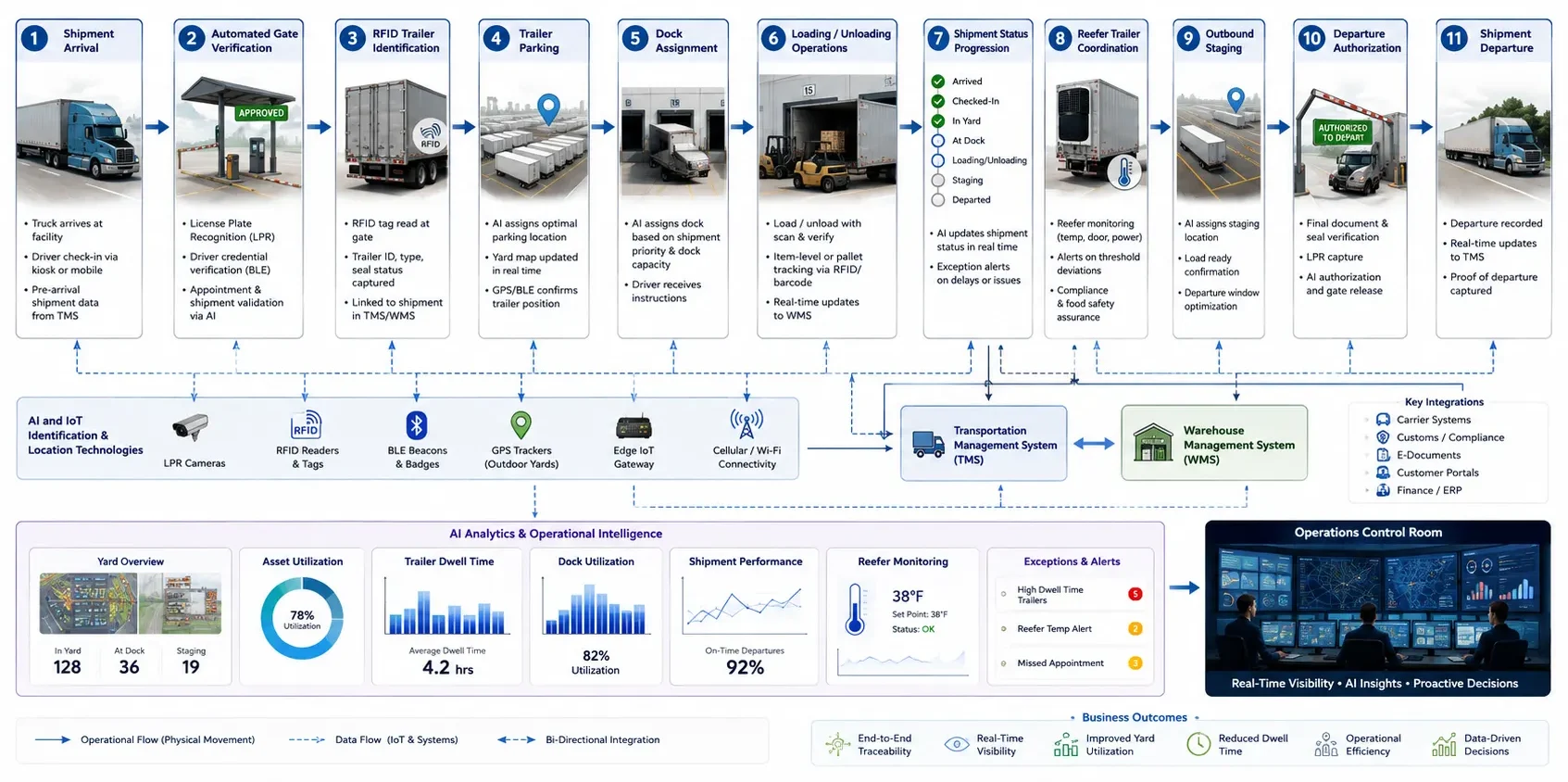
This workflow diagram illustrates the end-to-end shipment lifecycle across a modern trailer yard. It shows how AI and IoT technologies support automated gate verification, RFID trailer identification, trailer parking, dock assignment, loading and unloading, shipment status tracking, reefer trailer coordination, outbound staging, and departure authorization while integrating with TMS, WMS, and AI operational dashboards to deliver complete shipment traceability and real-time operational visibility.
Integration with Transportation and Warehouse Workflows
AI functions deliver greater operational value when connected with existing logistics software. Yard Management AI is designed to exchange operational information with Transportation Management Systems (TMS), Warehouse Management Systems (WMS), Enterprise Resource Planning (ERP) software, and related business applications.
Integration enables operational events to be shared automatically across departments, reducing duplicate data entry and improving coordination between transportation, warehouse, security, and logistics personnel.
Integrated workflows support:
- Carrier appointment management
- Trailer arrival notifications
- Driver verification updates
- Yard inventory synchronization
- Dock assignment coordination
- Shipment readiness reporting
- Outbound dispatch confirmation
- Enterprise reporting
Real-time synchronization ensures that operational decisions are based on current trailer locations and verified gate events rather than manual status updates.
Applications Across Different Yard Environments
Although the operational workflow varies by facility type, the underlying need for accurate identification, location awareness, and shipment coordination remains consistent. AI and IoT functions can be adapted to support a variety of logistics environments.
Distribution Center Yards
Large retail and industrial distribution centers benefit from improved trailer visibility, automated yard inventory, faster gate processing, and better coordination between transportation and warehouse operations.
Cross-Dock Facilities
Cross-dock operations require rapid trailer turnover. AI-assisted trailer identification and shipment progression tracking help reduce delays while supporting efficient freight transfers between inbound and outbound vehicles.
Manufacturing Shipping Yards
Manufacturing facilities coordinate raw material deliveries, finished goods shipments, and carrier scheduling. AI and IoT improves trailer utilization, gate verification, and dock planning while supporting production logistics.
Container Yards and Intermodal Facilities
Container handling operations benefit from automated container identification, gate verification, equipment visibility, and historical movement records that improve operational planning across rail and truck transportation.
Cold Chain Distribution Yards
Facilities supporting refrigerated logistics use AI and IoT to coordinate refrigerated trailer identification, shipment progression, dock scheduling, and operational visibility for temperature-controlled freight.
Multi-Site Logistics Networks
Organizations operating multiple logistics campuses gain centralized visibility into trailer inventory, carrier activity, and yard performance while maintaining local operational control at each facility.
AIoT Applications Across Multiple Trailer Yard Environments
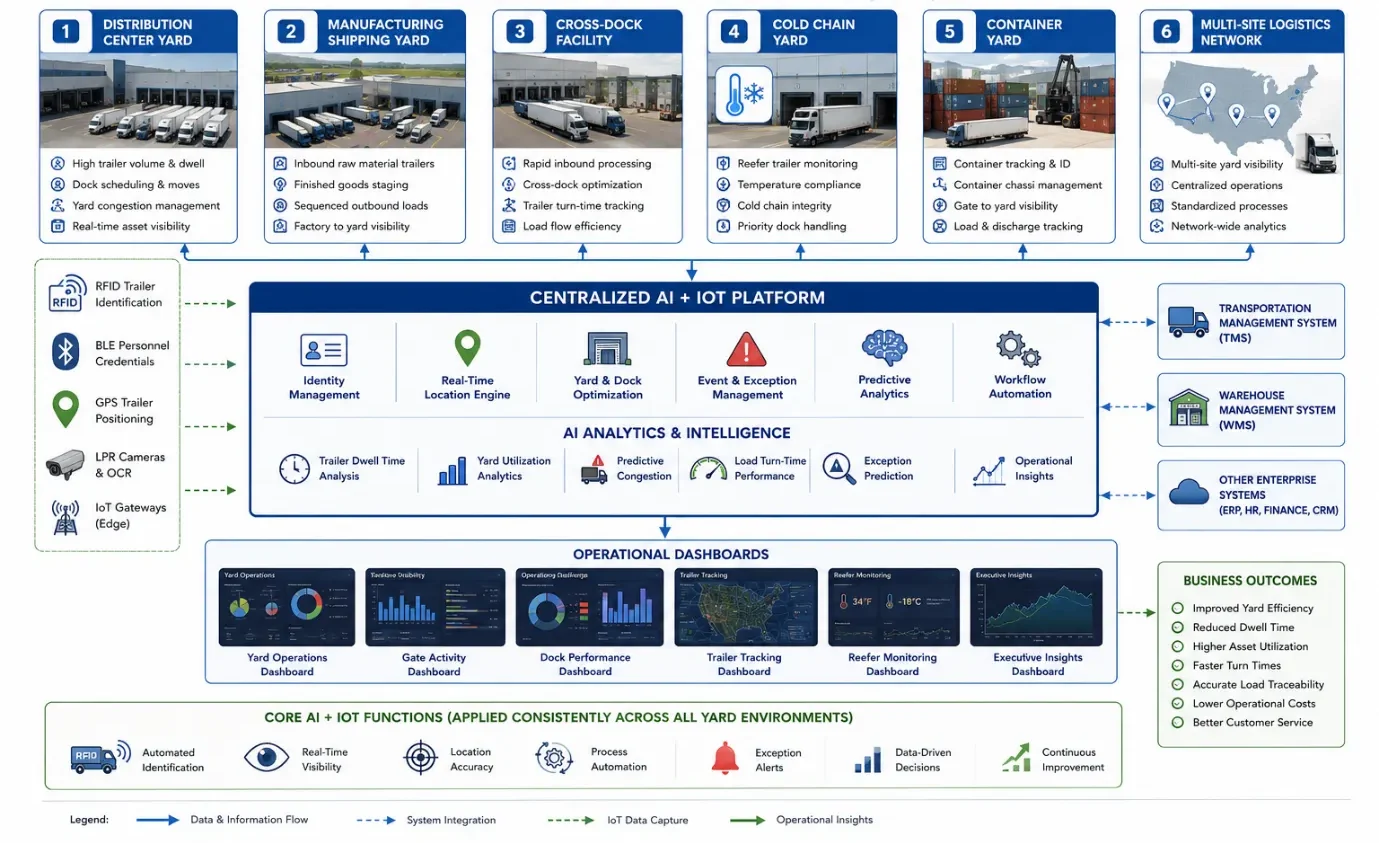
This enterprise applications diagram illustrates how a centralized AI and IoT platform supports multiple trailer yard environments through common identification, tracking, and operational intelligence capabilities. It connects distribution center yards, manufacturing shipping yards, cross-dock facilities, cold chain yards, container yards, and multi-site logistics networks with RFID trailer identification, BLE personnel credentials, GPS trailer positioning, license plate recognition, TMS, WMS, and centralized operational dashboards for end-to-end visibility and efficient yard management.
Why Organizations Choose Yard Management AI
Organizations implementing AI and IoT solutions for trailer yard operations require technology backed by practical deployment experience, reliable engineering, and long-term technical support.
Yard Management AI was created within Aperture Venture Studio with support from GAO. Building on more than two decades of IoT experience, the team has supported thousands of IoT customers and successfully delivered thousands of projects across industrial logistics and supply chain operations. This experience is reflected in continued investment in research and development, comprehensive quality assurance processes, and expert technical assistance available remotely or on-site.
Led by Ph.D. professionals and supported by experienced engineers and strategic partners, Yard Management AI has contributed to projects for Fortune 500 companies, leading research organizations, prestigious universities, and government agencies throughout the United States and Canada.
The result is enterprise AI and IoT software designed to improve trailer visibility, streamline gate operations, optimize yard performance, and support reliable logistics execution across modern trailer yards.
Advancing Trailer Yard Operations with AI and IoT
Trailer yards are essential to efficient freight movement, connecting transportation networks with warehouse operations, manufacturing facilities, and distribution centers. Maintaining accurate visibility of trailers, drivers, gate activities, and shipment progression helps organizations improve operational efficiency while reducing unnecessary delays and transportation costs.
By combining AI and IoT with RFID, BLE, GPS, cellular communications, computer vision, and enterprise software integration, Yard Management AI enables organizations to automate gate verification, strengthen trailer visibility, improve yard inventory accuracy, and support data-driven operational decisions. The result is a more coordinated, efficient, and transparent trailer yard capable of supporting today's increasingly complex logistics operations.