
Why Identification and Location Hardware Matters in Yard Operations
Trailer yards continuously experience vehicle arrivals, departures, trailer repositioning, driver check-ins, yard truck movement, shipment transfers, and inventory changes. Manual recording methods often create operational delays and inconsistent records that affect downstream transportation planning.
Identification and location hardware automates these activities by continuously recognizing assets, authorized personnel, and vehicle movements throughout designated yard zones.
Rather than relying solely on manual barcode scans or paperwork, AI and IoT hardware enables automated identification whenever trailers, tractors, containers, or drivers pass designated checkpoints.
Operational improvements include:
- Faster gate entry processing
- Accurate trailer identification
- Improved yard inventory visibility
- Reduced trailer search time
- Better trailer utilization
- Automated gate credential verification
- Improved carrier compliance
- Faster detention resolution
- Improved dock scheduling
- Better transportation planning
- Increased yard throughput
- Reduced manual administrative work
Large distribution facilities frequently manage thousands of trailer movements daily. Automated identification significantly reduces operational variability while improving planning accuracy across transportation and warehouse operations.
Yard Identification Devices
Hardware selection depends upon operational objectives, yard size, infrastructure layout, trailer movement frequency, communication coverage, and integration requirements.
Most enterprise deployments combine several complementary technologies instead of relying on only one identification method.
RFID Trailer Tags
RFID trailer tags provide automatic identification whenever trailers move through RFID read zones positioned at gate entrances, exit lanes, dock approaches, maintenance facilities, or designated traffic corridors.
Passive UHF RFID tags require no onboard power and can remain attached to trailers for many years with minimal maintenance.
Typical deployment locations include:
- Trailer chassis
- Dry van trailers
- Refrigerated trailers
- Flatbed equipment
- Container chassis
- Specialized transportation equipment
RFID identification allows gate systems to recognize trailer movements automatically without requiring drivers to stop for manual identification.
Benefits include:
- Fast trailer recognition
- Automated arrival records
- Reduced paperwork
- Improved trailer inventory
- Lower labor requirements
- Consistent identification accuracy
BLE Gate Beacons
Bluetooth Low Energy gate beacons establish defined proximity zones around gates, checkpoints, inspection lanes, parking areas, maintenance facilities, and restricted operating zones.
BLE communication supports proximity-based identification between infrastructure devices and authorized personnel carrying BLE-enabled identification badges or approved mobile devices.
BLE deployments commonly support:
- Driver arrival verification
- Authorized personnel recognition
- Gate proximity detection
- Restricted zone access
- Employee movement validation
- Yard vehicle assignment
Because BLE consumes very little power, devices often operate for extended periods while supporting large industrial deployments.
GPS Yard Trackers
GPS yard trackers provide continuous outdoor location information for trailers, chassis, yard tractors, mobile equipment, and transportation assets operating across large logistics facilities.
GPS hardware is especially valuable where trailers move frequently between parking areas, loading zones, maintenance locations, and outbound staging lanes.
Typical GPS applications include:
- Trailer positioning
- Yard truck location
- Fleet visibility
- Empty trailer management
- Equipment utilization
- Asset recovery
- Multi-yard visibility
- Carrier equipment tracking
GPS data helps operations teams reduce trailer search times while improving dispatch efficiency.
License Plate Recognition Cameras
License Plate Recognition (LPR) cameras automatically identify arriving and departing trucks by reading vehicle license plates without requiring manual data entry.
Combined with AI software, LPR cameras streamline gate operations by matching vehicle identification with scheduled appointments, authorized carriers, driver credentials, shipment documentation, and transportation records.
LPR deployments frequently support:
- Automated truck identification
- Carrier verification
- Entry authorization
- Exit validation
- Visit history
- Security investigations
- Gate automation
- Audit reporting
LPR systems significantly reduce gate congestion during peak arrival periods.
AI and RFID Technologies for Trailer Identification
RFID remains one of the most effective identification technologies for trailer yards because it enables rapid, contactless identification without requiring direct operator involvement. Fixed RFID readers positioned at strategic locations automatically recognize tagged trailers as they move through the facility, creating reliable movement records that support transportation planning and yard execution.
Within an AI and IoT deployment, RFID data becomes significantly more valuable when AI software analyzes movement history, traffic patterns, trailer utilization, and operational exceptions. Rather than simply recording identification events, AI helps operations teams understand how trailers move through the yard, where congestion occurs, and which assets require attention.
RFID Trailer Identification
RFID trailer identification supports automated recognition across:
- Entry gates
- Exit gates
- Dock approaches
- Cross-dock transfer lanes
- Trailer parking rows
- Inspection stations
- Maintenance facilities
- Security checkpoints
Automatic identification minimizes manual scanning while improving the accuracy of trailer inventories throughout the day.
RFID Gate Read Points
Gate read points serve as automated identification checkpoints where RFID readers detect tagged trailers entering or leaving controlled areas.
Common deployment locations include:
- Main security entrances
- Carrier check-in lanes
- Exit checkpoints
- Employee vehicle gates
- Dock access roads
- Internal traffic intersections
Well-designed read points improve gate throughput while reducing manual verification and administrative workload.
AI and BLE Technologies for Personnel Identification
Bluetooth Low Energy technology complements RFID by supporting proximity-based identification for personnel, contractors, drivers, supervisors, maintenance teams, and security staff. BLE is particularly useful where access decisions depend on authorized individuals rather than fixed assets.
Combined with AI software, BLE data provides greater operational awareness by confirming personnel presence, validating access permissions, and supporting workforce coordination throughout large outdoor facilities.
BLE Driver Badges
BLE-enabled driver badges simplify driver identification during arrival and departure procedures.
Common operational uses include:
- Driver verification
- Carrier identification
- Visitor registration
- Contractor authorization
- Yard employee identification
- Shift management
Automated recognition reduces manual document handling and accelerates gate processing while maintaining accurate personnel records.
BLE Proximity Gate Access
BLE proximity systems automatically recognize approved personnel as they approach controlled access points.
Typical applications include:
- Vehicle gates
- Pedestrian entrances
- Dispatch offices
- Maintenance workshops
- Equipment compounds
- Administrative buildings
AI software evaluates proximity events against business rules, helping organizations automate access decisions while maintaining appropriate security controls.
AI and GPS Technologies for Yard Location Tracking
GPS technology provides continuous location visibility across large outdoor facilities where trailers and vehicles move frequently. Unlike fixed identification points, GPS delivers ongoing positional updates that assist dispatchers, transportation coordinators, and yard managers in locating equipment quickly.
GPS tracking is especially valuable for facilities spanning hundreds of acres where manual searches can delay dock scheduling and carrier operations.
GPS Trailer Positioning
GPS trailer positioning supports continuous visibility for:
- Loaded trailers
- Empty trailers
- High-value shipments
- Returnable transportation assets
- Rental equipment
- Customer-owned trailers
Location history allows operations teams to reconstruct trailer movements, identify idle assets, and optimize parking assignments.
GPS Yard Truck Tracking
Yard trucks continually reposition trailers between parking rows, dock doors, inspection areas, and outbound staging zones. GPS tracking helps dispatchers monitor vehicle movement while improving task allocation and operational efficiency.
Benefits include:
- Improved dispatch coordination
- Reduced empty travel
- Better trailer assignments
- Faster dock servicing
- Improved yard productivity
- Better equipment utilization
AI software analyzes travel history to identify inefficient routing, recurring congestion, and opportunities for operational improvements.
AI and Cellular Technologies for Wide-Area Connectivity
Cellular communication extends identification and location visibility beyond individual facilities by enabling secure data exchange between mobile assets and enterprise software. Cellular connectivity is particularly useful for trailers operating across multiple distribution centers, regional yards, customer locations, and transportation routes.
Modern LTE and 5G networks provide reliable communication for mobile equipment without requiring dedicated local wireless infrastructure.
Cellular Trailer Trackers
Cellular trailer trackers provide long-range communication for assets moving between facilities.
Typical applications include:
- Multi-site trailer visibility
- Fleet coordination
- Carrier collaboration
- Equipment utilization reporting
- Transportation planning
- Asset recovery
- Shipment status updates
Cellular communication complements GPS tracking by transmitting location data to centralized software for enterprise-wide visibility.
Cellular Reefer Telemetry
Refrigerated trailers often require communication regarding refrigeration unit status while traveling between production facilities, distribution centers, and customer locations.
Cellular-enabled reefer communication supports:
- Refrigerated trailer identification
- Fleet coordination
- Distribution planning
- Cross-facility shipment visibility
- Cold chain logistics support
- Delivery scheduling
Although reefer units generate operational data, this page emphasizes the identification and location capabilities that integrate refrigerated assets into broader yard management workflows.
AIoT Technology Workflow for Modern Trailer Yard Operations
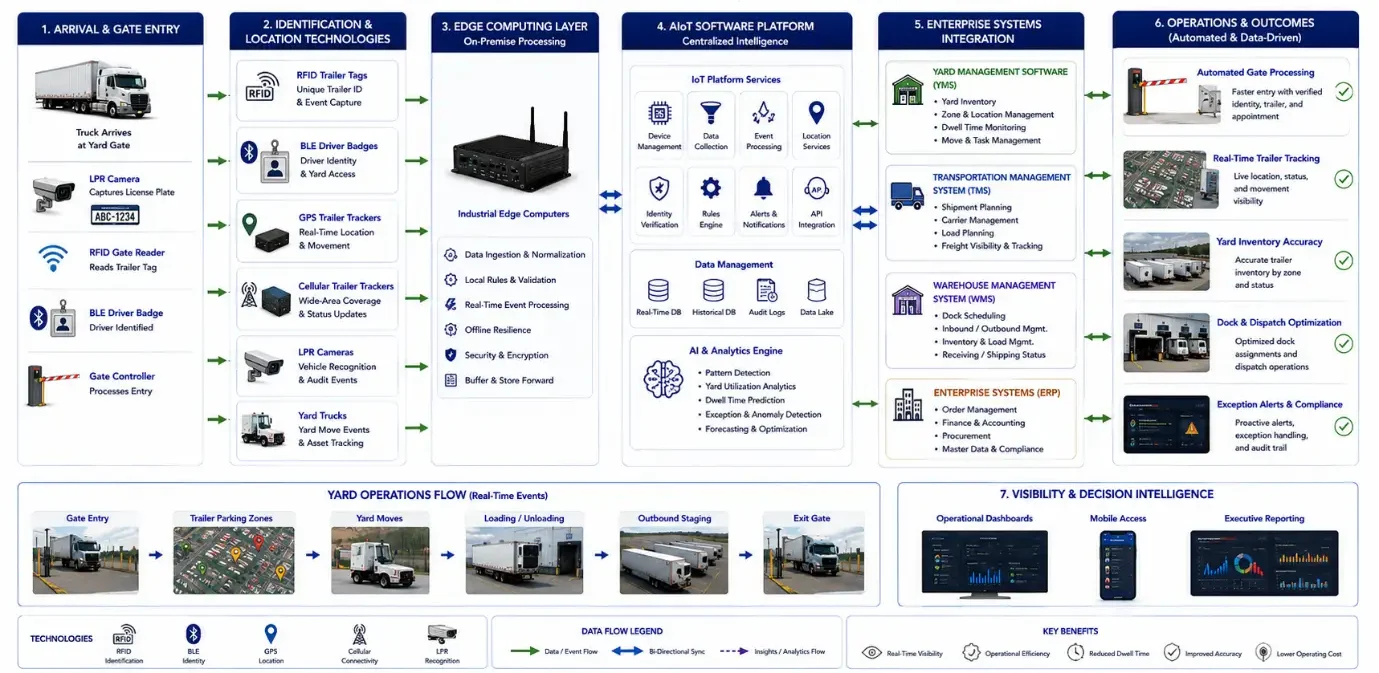
This enterprise workflow diagram illustrates how RFID trailer tags, BLE driver badges, GPS and cellular trailer trackers, license plate recognition cameras, and industrial edge computers work together with AI software, Yard Management Software (YMS), Transportation Management Systems (TMS), and Warehouse Management Systems (WMS). It demonstrates the end-to-end flow of identification and location data that automates gate processing, trailer tracking, yard inventory management, dock operations, and dispatch across a modern trailer yard.
Selecting Hardware for Gate and Yard Logistics
Choosing the appropriate hardware requires more than comparing device specifications. Distribution yards differ in size, traffic volume, trailer turnover, carrier diversity, environmental conditions, and operational workflows. A successful AI and IoT deployment begins with understanding how trailers, yard trucks, drivers, and freight move through the facility.
Many organizations combine multiple identification technologies rather than relying on a single device. RFID provides high-speed trailer identification at fixed checkpoints, BLE supports personnel and proximity-based access, GPS delivers continuous outdoor location visibility, while cellular communication enables connectivity across geographically distributed operations.
Important evaluation factors include:
- Yard size and physical layout
- Number of daily trailer movements
- Gate traffic volume
- Trailer ownership models
- Carrier participation
- Existing TMS and WMS compatibility
- Required identification accuracy
- Wireless communication coverage
- Outdoor environmental conditions
- Equipment maintenance requirements
- Expansion to additional facilities
- Long-term operational costs
Hardware should also support future operational growth without requiring complete infrastructure replacement. Selecting scalable identification technologies helps organizations accommodate additional gates, expanded parking areas, higher trailer volumes, and multi-site deployments.
Hardware Compatibility with Enterprise Software
Identification hardware delivers the greatest operational value when integrated with enterprise software responsible for transportation, warehouse operations, scheduling, and logistics execution.
Typical integration targets include:
- Yard Management Software
- Transportation Management Systems (TMS)
- Warehouse Management Systems (WMS)
- Enterprise Resource Planning (ERP)
- Dock Scheduling Software
- Carrier Management Systems
- Security Management Systems
- Fleet Management Software
- Dispatch Applications
- Business Intelligence Solutions
AI and IoT software consolidates identification events from RFID readers, BLE devices, GPS trackers, cellular communication hardware, and license plate recognition cameras into a unified operational view. This enables transportation planners, warehouse supervisors, dispatch teams, and security personnel to work from consistent, real-time information.
Organizations with multiple distribution centers also benefit from standardized hardware deployments, making it easier to maintain consistent operating procedures, simplify maintenance, and expand to new facilities.
Supporting Reliable Yard Operations Through Proven AI and IoT Experience
Yard Management AI was created within Aperture Venture Studio with support from GAO, drawing on more than two decades of IoT experience across industrial logistics environments. Thousands of completed IoT projects and long-term customer engagements have contributed practical knowledge to the development of identification and location solutions for gate and yard operations.
Research and development efforts are supported by rigorous quality assurance processes, experienced engineering teams, and remote or onsite technical assistance. Leadership from Ph.D. professionals, collaboration with strategic partners, and experience serving Fortune 500 companies, leading research organizations, prestigious universities, and government agencies in the United States and Canada contribute to dependable, enterprise-ready solutions for complex logistics environments.
This experience helps organizations evaluate the right combination of RFID, BLE, GPS, cellular communication, and AI and IoT software to meet operational objectives while supporting future expansion.
Applications Across Yard Management Operations
Identification and location hardware supports a broad range of operational environments where trailers, containers, vehicles, and freight assets must be identified accurately and located efficiently.
Common applications include:
- Distribution center yard operations
- Cross-dock logistics facilities
- Manufacturing shipping yards
- Retail distribution networks
- Third-party logistics providers
- Container terminal operations
- Port staging facilities
- Intermodal freight terminals
- Fleet equipment yards
- Refrigerated trailer staging
- Spare parts distribution centers
- Regional transportation hubs
- Multi-site logistics operations
- Bulk material transportation yards
Each environment presents unique operational challenges, but the common objective remains consistent: accurate identification, dependable location tracking, efficient gate processing, and improved yard visibility supported by AI and IoT technologies.
Build a Reliable Foundation for Automated Yard Visibility
Efficient yard management begins with dependable identification and location technologies. RFID trailer tags, BLE gate beacons, GPS trackers, license plate recognition cameras, and cellular communication devices provide the hardware foundation needed to automate gate operations, improve trailer visibility, streamline dispatch activities, and support enterprise logistics workflows.
When these technologies operate together with AI and IoT software, edge processing, and enterprise business systems, organizations gain greater operational transparency while reducing manual processes, trailer search times, detention costs, and gate congestion. Selecting the appropriate combination of hardware ensures that yard operations remain scalable, accurate, and ready to support evolving transportation and distribution requirements.
Relevant U.S. and Canadian Standards and Regulations for AI and IoT Hardware in Yard Management
The following standards, regulations, and industry specifications are commonly applicable to AI-enabled identification, location tracking, gate access, trailer identification, RFID, BLE, GPS, cellular communications, and related AI and IoT hardware used in yard management operations.
U.S. Standards and Regulations
- ISO/IEC 18000 Series (RFID Air Interface Standards)
- ISO/IEC 18046 (RFID Performance Test Methods)
- ISO/IEC 18047 (RFID Conformance Testing)
- ISO/IEC 29167 Series (RFID Security Services)
- GS1 EPCglobal Gen2 (EPC Class 1 Generation 2 UHF RFID)
- GS1 EPC Tag Data Standard (TDS)
- GS1 EPC Information Services (EPCIS) 2.0
- GS1 Core Business Vocabulary (CBV)
- ISO 17363 (RFID for Freight Containers)
- ISO 17364 (RFID for Returnable Transport Items)
- ISO 17365 (RFID for Transport Units)
- ISO 17366 (RFID for Product Packaging)
- ISO 17367 (RFID for Product Tagging)
- ISO 28000 (Supply Chain Security Management Systems)
- ISO 28001 (Supply Chain Security Best Practices)
- ISO 28002 (Supply Chain Resilience)
- ISO 28003 (Supply Chain Security Auditing Requirements)
- ISO 28004 Series
- ISO 9001
- ISO/IEC 27001
- ISO/IEC 27002
- ISO/IEC 27017
- ISO/IEC 27018
- ISO/IEC 27701
- ISO/IEC 30141
- ISO/IEC 27400
- NIST Cybersecurity Framework (CSF) 2.0
- NIST SP 800-53
- NIST SP 800-82
- NIST AI Risk Management Framework (AI RMF 1.0)
- FCC Part 15
- FCC Part 90 (where applicable)
- OSHA 29 CFR 1910
- OSHA Powered Industrial Truck Requirements
- SAE J2735 (where connected vehicle communications apply)
- ASTM E2659 (RFID Asset Management)
- ASTM F3411 (where applicable for unmanned operations)
Canadian Standards and Regulations
- Innovation, Science and Economic Development Canada (ISED) RSS Standards
- Canadian Electrical Code (CSA C22.1)
- CSA C22.2 Series
- CSA Z246 Series
- CSA Z1005
- CSA Z432
- CSA ISO 45001
- CSA ISO/IEC 27001
- CSA ISO/IEC 27002
- Personal Information Protection and Electronic Documents Act (PIPEDA)
- Canada Labour Code Part II
- Transportation of Dangerous Goods (TDG) Regulations (where applicable)
- National Safety Code (NSC) Standards (where applicable)
Leading Companies Serving AI and IoT Hardware for Yard Management
The following companies are recognized providers of technologies relevant to AI-enabled yard management, trailer identification, gate automation, asset tracking, RFID, BLE, GPS, cellular communications, AI software, and enterprise logistics integration.
RFID and Automatic Identification
- Zebra Technologies
- HID Global
- Avery Dennison
- Impinj
- Alien Technology
- SATO
- Checkpoint Systems
- Identiv
- GAO RFID
- CAEN RFID
BLE and Real-Time Location Solutions
- Kontakt.io
- BlueCats
- Quuppa
- HID Global
- Minew
- Accent Systems
- Gimbal
- Estimote
GPS and Fleet Tracking
- Geotab
- Samsara
- ORBCOMM
- CalAmp
- Verizon Connect
- Azuga
- Motive
- Linxup
Cellular Connectivity
- Sierra Wireless (Semtech)
- Telit Cinterion
- Quectel
- Thales
- MultiTech
- Digi International
License Plate Recognition and Computer Vision
- Genetec
- Axis Communications
- Bosch Security Systems
- Hanwha Vision
- Hikvision
- Motorola Solutions
- Vivotek
Yard Management Software
- Oracle
- SAP
- Blue Yonder
- Manhattan Associates
- Körber Supply Chain
- Siemens Digital Logistics
- Descartes Systems Group
- PINC
- Yard Management AI
Transportation and Warehouse Software
- Oracle Transportation Management
- SAP Transportation Management
- Blue Yonder Transportation Management
- Manhattan Active Transportation Management
- MercuryGate
- Descartes Systems Group
- Trimble
- e2open
Industrial Networking and Edge Computing
- Cisco
- HPE Aruba Networking
- Advantech
- Siemens
- Phoenix Contact
- Moxa
- Belden
- Red Lion Controls
Enterprise AI and IoT Solution Providers
- IBM
- Microsoft
- Amazon Web Services
- Google Cloud
- Siemens
- Honeywell
- Zebra Technologies
- GAO Tek
- Yard Management AI
These standards and technology providers align closely with AI-enabled identification and location solutions for yard management, supporting trailer identification, gate access control, personnel identification, yard asset tracking, inventory visibility, and enterprise logistics integration while maintaining a strong focus on RFID, BLE, GPS, and cellular technologies.
Case Studies
USA Case Studies
Dallas, Texas, USA
AI and RFID Trailer Identification and Gate Access for a High-Volume Distribution Yard
Problem
A major distribution yard serving regional manufacturing and retail operations was experiencing significant congestion at inbound and outbound gates. Hundreds of trailers, yard trucks, contractors, and drivers entered and exited the facility daily. Manual gate verification, paper-based trailer records, and radio communication created delays that increased trailer dwell time and reduced yard throughput.
Operations personnel also struggled to maintain accurate trailer location records. Yard dispatchers frequently spent considerable time locating trailers for outbound shipments, resulting in unnecessary yard truck movements, scheduling conflicts, and delayed loading activities. Visitor management and contractor access verification also required additional manual effort, increasing security risks and administrative workload.
The organization required an AI-enabled Identification and Location Solution capable of supporting trailer identification, automated gate credentialing, people tracking, access control, asset tracking, and yard inventory management without interrupting daily operations.
Solution
Yard Management AI designed and deployed an AI and IoT solution focused on trailer identification, gate automation, and yard visibility. Drawing upon our implementation experience together with GAO Tek Inc. and GAO RFID Inc., we integrated multiple identification technologies into a unified yard management solution while protecting confidential operational information.
The deployment combined:
- AI and RFID trailer identification
- AI and BLE driver authentication
- GPS trailer positioning
- License plate recognition
- Edge AI event processing
- Enterprise yard management software integration
GAO RFID Inc. UHF RFID Readers and UHF RFID Tags were installed at gate read points to automatically identify trailers during inbound and outbound movements. Multiple read zones provided accurate trailer verification while reducing manual barcode scanning and paperwork.
GAO Tek Inc. BLE Gateways and BLE Beacons supported driver credential verification. Authorized personnel carrying BLE badges were automatically recognized as vehicles approached gate checkpoints, allowing credential validation before gate entry.
GPS IoT Trackers supplied continuous trailer location information throughout storage lanes, overflow parking areas, and staging zones. Dispatchers could identify trailer locations without requiring manual yard inspections.
License Plate Recognition cameras added another identification layer by matching vehicle registration data with trailer identification records and authorized driver credentials.
Device Edge computing equipment processed RFID reads, BLE identification events, GPS updates, and camera recognition locally before synchronizing validated events with enterprise software.
The overall solution integrated with existing Yard Management Software, Transportation Management Software (TMS), and Warehouse Management Software (WMS), allowing dispatchers to view trailer movements using familiar operational dashboards.
Our implementation focused on Identification and Location Solutions rather than monitoring technologies, ensuring reliable trailer visibility throughout gate and yard operations.
Relevant hardware deployed included:
- GAO RFID UHF Readers
- GAO RFID UHF Trailer Tags
- GAO RFID Antennas
- GAO RFID Accessories
- GAO Tek BLE Gateways
- GAO Tek BLE Beacons
- GAO Tek GPS IoT Trackers
- GAO Tek Device Edge Computing Systems
Each hardware category was selected based on read range requirements, trailer movement speed, gate layout, wireless coverage, installation constraints, and enterprise integration requirements.
Result
Automated trailer identification significantly reduced manual gate processing activities while improving trailer visibility across the distribution yard.
Key operational improvements included:
- Approximately 35% reduction in average gate processing time
- More accurate trailer inventory records
- Faster trailer dispatch assignments
- Reduced trailer search time throughout storage lanes
- Improved access control compliance
- Better utilization of yard trucks
- More consistent trailer location accuracy
- Reduced manual administrative workload
Operational teams gained a continuously updated digital representation of trailer locations, allowing dispatchers to make routing decisions using current identification data instead of manual radio communication.
Chicago, Illinois, USA
AI and BLE Workforce Visibility and RFID Yard Inventory Management for Cross-Dock Operations
Problem
A busy cross-dock yard supporting regional freight consolidation experienced continual challenges managing trailer arrivals, temporary staging, personnel movement, and outbound scheduling.
Dispatch teams often lacked accurate information regarding trailer locations, available dock positions, and yard personnel assignments. Manual inventory verification required employees to physically inspect parking rows before assigning trailers to loading docks.
Contractor management presented another operational challenge. Temporary workers, third-party drivers, and maintenance personnel required rapid authorization while maintaining strict access control procedures throughout secure operational areas.
The organization sought an AIoT solution that would improve people tracking, access control, trailer identification, yard inventory accuracy, and asset utilization while minimizing disruption to existing logistics workflows.
Solution
Yard Management AI implemented an Identification and Location Solution using AI and BLE, AI and RFID, GPS tracking, and edge computing technologies. Our deployment experience together with GAO Tek Inc. and GAO RFID Inc. enabled the organization to modernize yard operations without replacing existing enterprise software.
Driver identification relied on BLE Driver Badges supported by GAO Tek BLE Gateways positioned throughout gate lanes, dispatch offices, maintenance areas, and operational zones.
Authorized personnel were automatically recognized as they entered designated operational areas. Access permissions were validated before entry into restricted trailer staging locations, reducing manual credential verification.
Trailer identification was handled using GAO RFID UHF Tags permanently assigned to trailer assets.
RFID Gate Read Points automatically identified trailers entering:
- Receiving lanes
- Cross-dock staging areas
- Temporary parking rows
- Outbound shipping lanes
- Maintenance locations
AI software correlated RFID identification events with transportation schedules, dock assignments, and trailer inventory records to improve trailer dispatch planning.
GPS IoT Trackers installed on selected yard trucks supplied real-time vehicle positioning information, enabling dispatch supervisors to optimize trailer movement assignments and reduce unnecessary travel.
Device Edge Computing equipment processed identification events close to operational areas, reducing communication latency while maintaining synchronization with centralized yard management software.
The deployment incorporated hardware from multiple GAO technology categories, including:
- GAO RFID UHF Readers
- GAO RFID Reader Modules
- GAO RFID Antennas
- GAO RFID UHF Trailer Tags
- GAO Tek BLE Products
- GAO Tek BLE Accessories
- GAO Tek GPS IoT Devices
- GAO Tek Device Edge Computing Systems
Each technology supported a specific operational requirement without creating unnecessary complexity. RFID handled high-speed trailer identification, BLE verified personnel credentials, GPS tracked mobile assets, and edge computing coordinated event processing.
AI and IoT software analyzed movement history, trailer dwell patterns, gate utilization, and yard inventory changes to assist dispatch personnel in making more informed operational decisions.
Because the solution emphasized Identification and Location Solutions rather than monitoring systems, implementation remained aligned with the organization's operational priorities.
Result
Following deployment, operational performance improved across multiple areas.
Measured improvements included:
- Approximately 28% reduction in trailer search time
- Improved yard inventory accuracy
- Faster driver authentication at controlled access points
- Better trailer utilization across staging areas
- Reduced manual inventory reconciliation
- Improved dispatch planning efficiency
- Lower administrative effort for contractor access management
Operational supervisors gained improved visibility into trailer movement history, personnel authorization status, and available trailer inventory without requiring repeated physical yard inspections.
The integrated AI and RFID and AI and BLE solution also improved communication between dispatch, warehouse operations, transportation scheduling, and security teams through shared operational data.
Savannah, Georgia, USA
AI and GPS Trailer Positioning and AI and RFID Container Identification for Multi-Site Yard Management
Problem
A large logistics organization operated multiple trailer yards supporting regional distribution centers and cross-dock facilities throughout the southeastern United States. Daily operations involved thousands of trailer movements between staging areas, outbound shipping lanes, overflow parking, maintenance locations, and customer delivery schedules.
Operations teams relied on manual trailer location updates and periodic yard inspections to maintain inventory accuracy. Trailer assignments occasionally became outdated because movements were recorded after relocation rather than at the moment of movement. Dispatchers frequently spent valuable time locating equipment before assigning yard trucks, increasing dwell time and reducing trailer utilization.
Management also wanted improved visibility across multiple yard locations while maintaining secure gate access for employees, contractors, and visiting drivers. The organization required an AI-enabled Identification and Location Solution capable of improving trailer tracking, asset visibility, access control, inventory accuracy, and shipment traceability without replacing existing transportation software.
Solution
Yard Management AI designed and deployed an AI and IoT solution centered on trailer identification, GPS positioning, and automated gate verification. Drawing upon implementation experience from GAO Tek Inc. and GAO RFID Inc., we integrated proven identification technologies with existing yard management operations while preserving established logistics workflows.
The solution combined:
- AI and RFID trailer identification
- AI and GPS trailer positioning
- AI and BLE personnel authentication
- Cellular communication for mobile assets
- License plate recognition at gate entrances
- Device Edge computing for local event processing
GAO RFID Inc. UHF RFID Readers and UHF RFID Tags were installed at strategic gate checkpoints, inspection lanes, and transfer areas. Every trailer movement generated an automatic identification event, allowing the yard management software to maintain accurate trailer records without manual data entry.
GAO Tek GPS IoT Trackers were mounted on trailers requiring continuous location visibility throughout large storage yards. GPS positioning complemented RFID identification by providing trailer location information even after trailers moved beyond RFID read zones.
BLE Gateways and BLE Beacons authenticated authorized drivers and yard personnel before access was granted to controlled operational areas. Driver credentials were verified automatically as vehicles approached designated access points, improving security while reducing manual verification.
Selected trailers transporting temperature-sensitive freight also used Cellular IoT Devices to transmit reefer operational status while traveling between distribution yards. Although the primary objective remained identification and location, cellular communication ensured that trailer location records remained synchronized during interfacility movements.
Device Edge Computing systems processed RFID reads, GPS updates, BLE events, and camera recognition locally before forwarding validated records to enterprise Yard Management Software, Transportation Management Software, and Warehouse Management Software.
Hardware deployed as part of the solution included:
- GAO RFID UHF Readers
- GAO RFID UHF Trailer Tags
- GAO RFID Antennas
- GAO RFID Reader Modules
- GAO Tek GPS IoT Trackers
- GAO Tek Cellular IoT Devices
- GAO Tek BLE Gateways
- GAO Tek BLE Beacons
- GAO Tek Device Edge Computing Systems
Hardware selection emphasized durability for outdoor yard environments, long communication range, dependable identification accuracy, and compatibility with existing enterprise software.
Result
The AI and IoT deployment significantly improved operational visibility across multiple yard locations.
Measured operational improvements included:
- Approximately 31% reduction in trailer search time across participating yard locations
- Improved trailer inventory consistency between facilities
- Faster gate credential verification
- Better trailer utilization throughout storage and staging areas
- Reduced manual inventory reconciliation
- Improved dispatch planning for yard truck operations
- Greater shipment traceability during trailer transfers
Operations personnel were able to identify trailer availability more quickly, reducing unnecessary yard truck travel and improving outbound scheduling accuracy. Multi-site visibility also supported better coordination between dispatchers responsible for separate distribution facilities.
Canada Case Studies
Brampton, Ontario, Canada
AI and BLE Personnel Access and AI and RFID Yard Inventory for Regional Distribution Operations
Problem
A regional distribution organization operating a busy trailer yard in Brampton managed frequent inbound deliveries, outbound shipments, contractor access, and temporary trailer storage for multiple warehouse facilities.
Daily activities involved numerous trailers entering and leaving secured yard areas while drivers, maintenance personnel, visitors, and contractors required controlled access to operational zones. Manual trailer inventories often became outdated because equipment was relocated throughout the day without immediate record updates.
Supervisors also needed improved visibility into yard occupancy, trailer availability, and personnel movement to support efficient dock scheduling and reduce unnecessary trailer repositioning. The organization sought an AI and IoT solution focused on identification, location tracking, access management, and inventory control while maintaining compatibility with existing warehouse and transportation software.
Solution
Yard Management AI implemented an integrated AIoT Identification and Location Solution using technologies supplied through our experience with GAO Tek Inc. and GAO RFID Inc. The deployment emphasized reliable trailer identification, personnel credential verification, and inventory automation while avoiding disruption to established logistics procedures.
The solution incorporated:
- AI and RFID trailer identification
- AI and BLE access control
- GPS yard truck tracking
- License plate recognition
- Edge AI processing
- Enterprise software integration
GAO RFID Inc. UHF Trailer Tags were assigned to trailers operating within the yard. UHF Readers positioned at entrance gates, outbound exits, maintenance areas, and trailer transfer points automatically recorded trailer movements as equipment passed designated read zones.
BLE Driver Badges and BLE Gateways supplied secure personnel identification. Drivers, contractors, and authorized employees were recognized before entering restricted operational areas, helping security personnel validate credentials without extensive manual document reviews.
GPS IoT Trackers installed on yard tractors provided dispatchers with continuous visibility into vehicle location and movement history. This information supported more efficient trailer relocation and reduced unnecessary travel throughout the yard.
License Plate Recognition cameras supplied an additional identification layer by matching vehicle registration records with authorized driver credentials and trailer assignments.
Device Edge Computing equipment processed identification events locally before securely synchronizing operational records with Warehouse Management Software, Transportation Management Software, and Yard Management Software.
Hardware incorporated into the deployment included:
- GAO RFID UHF Readers
- GAO RFID UHF Tags
- GAO RFID Antennas
- GAO RFID Accessories
- GAO Tek BLE Gateways
- GAO Tek BLE Products
- GAO Tek GPS IoT Devices
- GAO Tek Device Edge Computing Systems
Each hardware category was selected according to communication range, environmental durability, identification accuracy, installation flexibility, and compatibility with existing yard infrastructure.
Throughout implementation, we worked with operational teams to configure identification workflows that reflected actual trailer movement practices rather than requiring personnel to adopt entirely new operating procedures. This approach reduced implementation complexity while supporting long-term operational consistency.
Result
Following deployment, the organization achieved measurable improvements across yard management operations.
Key outcomes included:
- Approximately 30% reduction in manual trailer inventory verification time
- Faster personnel credential validation at controlled access points
- Improved trailer location accuracy
- Better utilization of available yard parking capacity
- Reduced administrative workload for contractor management
- Improved dispatch efficiency through more accurate trailer visibility
- Enhanced shipment traceability for outbound logistics planning
Operations personnel gained greater confidence in trailer inventory records because identification events were captured automatically as trailers moved through operational checkpoints. Dispatch teams could assign trailers using current location information rather than relying on periodic manual inventory updates.
Lesson Learned
Successful yard management deployments require identification technologies to align with established logistics workflows. Combining BLE personnel verification, RFID trailer identification, GPS vehicle positioning, and edge processing creates a balanced solution that improves operational efficiency while minimizing disruption to day-to-day yard activities.