
Yard Management Documentation
Comprehensive documentation establishes the operational foundation for reliable AI and IoT yard management deployments. Well-organized technical documentation improves implementation consistency, simplifies maintenance activities, reduces troubleshooting time, and supports long-term operational continuity across multiple facilities.
Documentation should be created before installation begins and continuously updated throughout the operational life of the solution. Accurate records also simplify future expansion projects, software upgrades, infrastructure modernization, and personnel transitions.
Typical documentation categories include:
- System design documentation
- Operational procedures
- Hardware inventories
- Identification standards
- Integration specifications
- User administration
- Maintenance documentation
- Security procedures
- Disaster recovery planning
- Change management records
Consistent documentation ensures that operational knowledge remains available regardless of staffing changes or organizational growth.
Operational Process Documentation
Every trailer yard follows unique operational workflows based on facility layout, transportation schedules, customer requirements, carrier policies, dock assignments, and available parking capacity.
Operational documentation should clearly define each stage of trailer movement, including:
- Driver arrival
- Security verification
- Gate authorization
- Trailer identification
- Parking assignment
- Dock assignment
- Loading operations
- Unloading operations
- Trailer relocation
- Departure authorization
- Exit verification
Documented workflows help ensure consistent execution across multiple shifts while supporting employee training and operational auditing.
Identification Standards
Reliable identification remains one of the most important elements of enterprise yard management.
Organizations should maintain standardized documentation covering:
- Trailer numbering conventions
- RFID tag assignments
- BLE beacon identifiers
- Driver credential formats
- Carrier identification codes
- Gate numbering
- Parking location identifiers
- Dock numbering
- Yard zone definitions
- Visitor identification procedures
Standardized identification minimizes duplicate records while improving interoperability with transportation management software, warehouse systems, and enterprise reporting applications.
Hardware Documentation
Accurate hardware records simplify maintenance, troubleshooting, upgrades, and lifecycle planning.
Documentation typically includes:
- RFID readers
- RFID antennas
- BLE gateways
- BLE beacons
- GPS tracking devices
- Cellular communication devices
- License plate recognition cameras
- Edge computing equipment
- Network switches
- Power systems
- Backup equipment
- Communication infrastructure
Each deployed device should include documented installation locations, firmware versions, communication settings, maintenance history, replacement schedules, and operational status.
Software Configuration Documentation
Configuration documentation provides a permanent reference for software settings and operational rules.
Common documentation areas include:
- User roles
- Access permissions
- Gate authorization rules
- Trailer status definitions
- Carrier profiles
- Driver credential management
- Alert configurations
- Event logging
- Reporting parameters
- Integration interfaces
- Backup schedules
- System recovery procedures
Configuration documentation significantly reduces recovery time following software updates or infrastructure maintenance.
Network and Communication Documentation
Reliable communications are essential for maintaining continuous identification and location visibility throughout trailer yard operations.
Documentation should include communication methods supporting:
- RFID identification
- BLE communications
- GPS positioning
- Cellular connectivity
- Ethernet infrastructure
- Wi-Fi communications
- VPN connectivity
- Secure remote administration
- Time synchronization
- Communication redundancy
Proper documentation assists network administrators when expanding coverage or diagnosing connectivity issues.
Documentation Best Practices for Enterprise Yard Operations
Enterprise documentation should remain accurate, searchable, and continuously maintained rather than becoming static project records.
Recommended practices include:
- Maintain version-controlled documentation
- Record every configuration modification
- Document all software integrations
- Track hardware replacement history
- Standardize naming conventions
- Archive previous configuration versions
- Maintain network diagrams
- Record firmware revisions
- Document operational procedures
- Update maintenance schedules
- Store deployment photographs
- Maintain backup documentation offline
Organizations managing multiple facilities should standardize documentation templates across every location to simplify operational comparisons and future deployments.
AIoT Yard Management Documentation Lifecycle
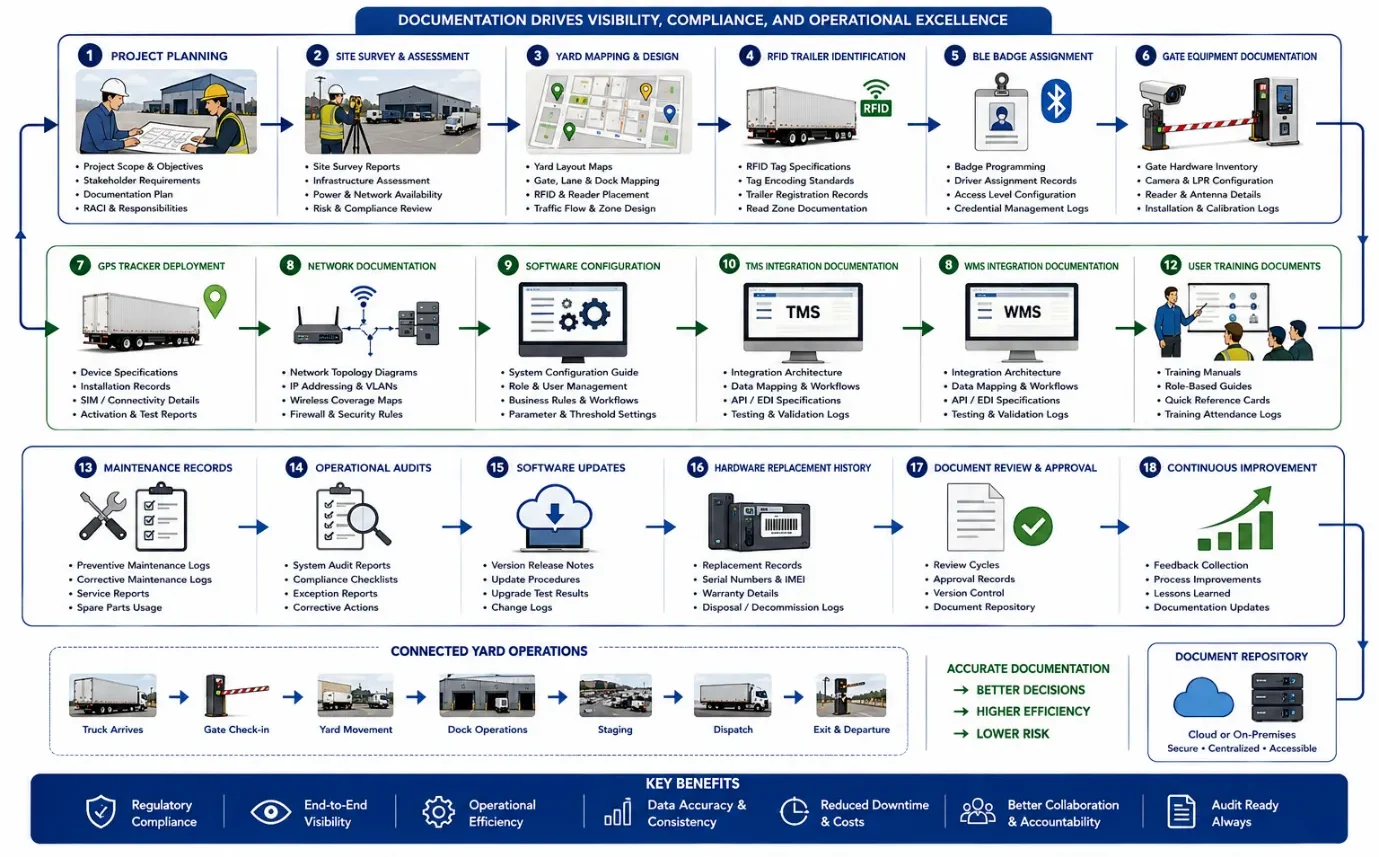
This technical workflow diagram illustrates the complete documentation lifecycle for AI and IoT yard management deployments. It follows the process from project planning, site surveys, yard mapping, RFID and BLE deployment planning, equipment and network documentation, software configuration, TMS and WMS integration, user training, maintenance records, operational audits, software updates, hardware replacement history, and continuous documentation improvement to support compliance, operational efficiency, and long-term system reliability.
Yard AIoT FAQs
Technical teams responsible for trailer yard operations often evaluate AI and IoT solutions from operational, integration, cybersecurity, and deployment perspectives. The following frequently asked questions address common topics encountered during planning, procurement, implementation, and long-term management of AIoT-enabled yard management systems.
What is AIoT in yard management?
AIoT combines artificial intelligence with connected industrial devices, identification technologies, and enterprise software to improve trailer yard operations. Rather than relying on manual updates, personnel can use AI-assisted event processing together with RFID, BLE, GPS, computer vision, and enterprise software integrations to automate gate transactions, trailer identification, asset visibility, and operational workflows.
Within yard management, AI and IoT primarily supports:
- Trailer identification
- Driver verification
- Personnel location awareness
- Gate automation
- Asset utilization analysis
- Trailer inventory management
- Yard movement visibility
- Transportation coordination
- Warehouse synchronization
How does AI and IoT improve trailer yard visibility?
Traditional yards often depend on manual trailer searches, paper records, or periodic yard checks.
AI and IoT improves visibility by combining:
- RFID trailer identification
- BLE-based personnel location
- GPS trailer positioning
- License plate recognition
- AI-assisted event processing
- Automated location updates
- TMS synchronization
- WMS synchronization
Operations teams receive near real-time information regarding trailer locations, movement history, dwell duration, loading status, and gate activities.
Which wireless technologies are commonly used in yard management?
Technology selection depends on yard size, infrastructure, trailer movement frequency, and enterprise integration requirements.
Common technologies include:
- UHF RFID for trailer identification
- BLE for personnel identification
- GPS for trailer positioning
- Cellular IoT for long-distance communications
- Wi-Fi HaLow where extended wireless coverage is required
- LoRaWAN for selected identification applications
- NFC for maintenance and service verification
- Edge computing for local event processing
Many enterprise deployments combine multiple technologies rather than relying on a single wireless method.
Why is RFID widely used for trailer identification?
RFID enables automated identification without requiring manual barcode scanning.
Typical advantages include:
- Fast gate processing
- Reliable trailer identification
- Reduced manual data entry
- Improved inventory accuracy
- Better movement history
- Automated yard transactions
- Lower processing delays
- Integration with transportation software
RFID readers positioned at gate lanes automatically identify trailers as they enter or leave the yard.
How does BLE support personnel management?
BLE technologies are frequently used for:
- Driver identification
- Contractor verification
- Visitor management
- Restricted area access
- Personnel presence detection
- Location awareness
- Emergency accountability
- Workforce movement records
BLE badges communicate with strategically located gateways to provide location updates while minimizing battery consumption.
What role does GPS play in trailer yard operations?
GPS tracking supports visibility for trailers operating beyond fixed identification zones.
Typical applications include:
- Trailer positioning
- Yard tractor tracking
- Fleet visibility
- Inter-yard movements
- Remote trailer monitoring
- Long-distance transportation
- Arrival prediction
- Dispatch coordination
GPS becomes particularly valuable for organizations operating multiple distribution facilities.
Can AI and IoT integrate with existing TMS software?
Yes.
Modern yard management solutions commonly exchange information with Transportation Management Systems using APIs, secure middleware, message queues, or enterprise integration software.
Typical shared information includes:
- Trailer arrivals
- Gate transactions
- Dock assignments
- Dispatch instructions
- Shipment status
- Carrier schedules
- Trailer availability
- Yard inventory
Integration minimizes duplicate data entry while improving operational consistency.
Can AIoT integrate with Warehouse Management Systems?
Warehouse operations and trailer yards function as closely connected operational areas.
Typical WMS integration supports:
- Dock scheduling
- Trailer allocation
- Receiving coordination
- Shipping confirmation
- Yard inventory
- Dock availability
- Load progression
- Trailer release
Warehouse teams receive updated trailer information without manually contacting gate personnel.
Does AI and IoT replace existing yard management software?
Generally, no.
Most organizations retain existing Yard Management Systems while integrating AI-assisted automation and identification technologies.
AI and IoT commonly enhances:
- Data collection
- Event verification
- Location accuracy
- Automated notifications
- Operational analytics
- Decision support
- Exception handling
Existing operational workflows usually remain in place while automation increases.
What is edge processing for gate events?
Edge processing performs selected computations close to gate equipment rather than transferring every transaction immediately to centralized systems.
Benefits include:
- Lower network dependency
- Faster gate response
- Reduced communication latency
- Local event validation
- Temporary offline operation
- Immediate identification decisions
- Improved operational continuity
Processed information synchronizes with enterprise software once communication is available.
How does AI improve gate access control?
AI assists gate operations by automatically evaluating multiple information sources before authorizing entry.
Examples include:
- License plate recognition
- Driver credential verification
- Trailer identification
- Appointment validation
- Vehicle authorization
- Arrival matching
- Access policy enforcement
- Exception detection
Automated verification reduces manual gate processing while maintaining security policies.
How is trailer dwell time calculated?
Trailer dwell time measures the duration between arrival and departure or between defined operational milestones.
AI-assisted software calculates dwell using:
- Gate entry timestamps
- RFID transactions
- GPS movement records
- Yard location history
- Dock assignments
- Departure confirmation
Operations managers use dwell analysis to identify bottlenecks affecting throughput.
How does AI and IoT support cross-dock facilities?
Cross-dock operations require rapid trailer turnover.
AI and IoT assists through:
- Trailer identification
- Dock assignment coordination
- Arrival visibility
- Shipment progression
- Trailer prioritization
- Loading verification
- Dispatch readiness
- Transportation synchronization
These capabilities help reduce unnecessary trailer waiting time.
Is AIoT suitable for container yards?
Yes.
Container yards frequently deploy AI-assisted identification technologies to support:
- Container location
- Gate automation
- Equipment coordination
- Movement verification
- Storage optimization
- Fleet scheduling
- Yard utilization
- Operational reporting
Solutions can scale from regional terminals to large container handling facilities.
How does AI and IoT support cold chain yards?
Cold chain operations emphasize identification accuracy, traceability, and coordinated trailer movement.
AI and IoT assists by supporting:
- Reefer trailer identification
- Cold storage trailer allocation
- Shipment traceability
- Arrival coordination
- Yard inventory
- Driver verification
- Dispatch management
- Distribution visibility
Where refrigeration telemetry is required, cellular communications can complement identification technologies without changing core yard workflows.
Implementation Guides
Successful AIoT projects begin with operational planning rather than technology selection alone. Organizations benefit from structured implementation methods that align identification technologies, enterprise software, operational procedures, and long-term maintenance requirements.
Initial Operational Assessment
Implementation teams typically evaluate:
- Current yard processes
- Gate throughput
- Trailer inventory accuracy
- Carrier workflows
- Driver processing procedures
- Existing software
- Communication infrastructure
- Operational objectives
This assessment establishes measurable project goals before deployment begins.
Site Survey and Coverage Planning
A detailed site survey identifies optimal locations for:
- RFID gate readers
- BLE gateways
- GPS-enabled assets
- License plate recognition cameras
- Edge computing equipment
- Communication links
- Power availability
- Network connectivity
Proper placement improves identification reliability while reducing unnecessary infrastructure costs.
Hardware Selection
Technology choices should align with operational requirements rather than using identical hardware across every facility.
Typical hardware categories include:
- RFID trailer tags
- BLE driver badges
- BLE gateways
- GPS trailer trackers
- Cellular communication devices
- RFID gate readers
- RFID antennas
- License plate recognition cameras
- Edge computing systems
Selection depends on trailer movement frequency, facility size, environmental conditions, and integration requirements.
Enterprise Software Integration
Deployment teams define interfaces with:
- Transportation Management Systems
- Warehouse Management Systems
- Enterprise Resource Planning software
- Security management systems
- Identity management systems
- Reporting software
- Business analytics tools
- Maintenance applications
Early integration planning minimizes deployment delays during commissioning.
Deployment Checklists for Gate and Yard Hardware
Successful AI and IoT yard management deployments depend on structured planning before hardware installation begins. Deployment checklists help technical teams standardize implementation activities, reduce commissioning delays, and improve long-term operational reliability across trailer yards, distribution centers, container facilities, and cross-dock operations.
Gate Entry Readiness Checklist
Before installing gate identification equipment, project teams should verify operational requirements and physical infrastructure.
Operational Validation
- Confirm vehicle entry and exit workflows.
- Document driver authentication procedures.
- Identify visitor and contractor access requirements.
- Review carrier appointment processes.
- Define trailer identification policies.
- Verify emergency vehicle access procedures.
- Document exception handling workflows.
- Identify operational peak traffic periods.
Infrastructure Validation
- Confirm power availability.
- Verify network connectivity.
- Validate communication redundancy.
- Inspect mounting locations.
- Confirm cable routing.
- Review environmental protection requirements.
- Verify equipment accessibility.
- Identify maintenance access points.
RFID Deployment Checklist
RFID identification systems require careful planning to ensure consistent read performance and dependable trailer identification.
Deployment activities typically include:
- Confirm trailer tagging standards.
- Verify RFID tag mounting positions.
- Install gate readers.
- Validate antenna orientation.
- Perform read-range testing.
- Configure read zones.
- Eliminate overlapping coverage.
- Validate identification accuracy.
- Test simultaneous trailer movement.
- Confirm software integration.
- Verify event logging.
- Complete commissioning documentation.
BLE Deployment Checklist
BLE-based personnel identification supports workforce visibility while reducing manual check-in activities.
Implementation planning should include:
- Driver badge assignment procedures.
- Personnel enrollment.
- Gateway positioning.
- Coverage validation.
- Identity synchronization.
- Badge lifecycle management.
- Visitor credential management.
- Battery replacement planning.
- Security policy verification.
- Location accuracy testing.
- Event validation.
- User acceptance testing.
GPS Deployment Checklist
GPS tracking is commonly deployed where trailers frequently move between facilities or operate across large terminal yards.
Deployment tasks include:
- Install trailer tracking devices.
- Validate GPS reception.
- Configure cellular communications.
- Register tracking devices.
- Test location reporting.
- Validate movement history.
- Configure reporting intervals.
- Test roaming coverage.
- Verify battery performance.
- Validate geofencing.
- Confirm dispatch integration.
- Complete operational testing.
Reference Material for TMS and WMS Integration
Enterprise yard management software rarely operates independently. Integration with transportation, warehouse, and enterprise business software allows operational information to move automatically between departments while reducing duplicate data entry.
Organizations planning AIoT deployments should establish data governance, interface standards, synchronization policies, and integration testing procedures before production rollout.
Common TMS Data Exchange
Transportation Management Systems commonly exchange operational data with yard management software.
Typical information includes:
- Trailer arrivals.
- Carrier appointments.
- Gate transactions.
- Trailer departures.
- Dispatch schedules.
- Driver assignments.
- Equipment availability.
- Transportation status.
- Yard inventory updates.
- Dwell time reports.
These integrations improve coordination between dispatch operations and trailer yard personnel.
Common WMS Data Exchange
Warehouse Management Systems require timely yard information to coordinate dock scheduling and freight movement.
Typical synchronized information includes:
- Dock assignments.
- Receiving schedules.
- Shipping schedules.
- Trailer availability.
- Yard inventory.
- Load progression.
- Trailer release authorization.
- Shipment completion.
- Equipment allocation.
- Operational alerts.
Automated synchronization reduces communication delays between warehouse operations and yard personnel.
ERP Integration Considerations
Enterprise Resource Planning software may exchange operational information with yard management solutions to support broader business processes.
Typical ERP interactions include:
- Asset records.
- Equipment status.
- Operational reporting.
- Financial reconciliation.
- Maintenance scheduling.
- Workforce management.
- Procurement records.
- Compliance documentation.
Well-defined interfaces help maintain consistent operational records across multiple enterprise systems.
Data Synchronization Best Practices
Consistent data synchronization improves operational reliability across distributed facilities.
Recommended practices include:
- Standardize event definitions.
- Synchronize time sources.
- Maintain unique equipment identifiers.
- Validate transaction sequencing.
- Prevent duplicate records.
- Monitor synchronization status.
- Archive historical transactions.
- Maintain audit logs.
- Protect transmitted information.
- Perform regular interface validation.
These practices help preserve data consistency while supporting accurate operational reporting.
Applications Across Yard Management Operations
The technical guidance presented throughout this Knowledge Center supports a wide variety of operational environments where trailer identification, personnel visibility, access management, and enterprise software integration are essential.
Organizations responsible for yard management frequently use these resources when planning or expanding AI and IoT initiatives in:
- Distribution center trailer yards.
- Cross-dock facilities.
- Container terminals.
- Manufacturing shipping yards.
- Retail distribution hubs.
- Cold chain logistics facilities.
- Transportation carrier terminals.
- Regional trailer pools.
- Intermodal logistics centers.
- Multi-site yard networks.
Each environment presents unique operational requirements, yet all benefit from structured implementation planning, standardized documentation, accurate identification technologies, and reliable integration with transportation and warehouse software.
Supporting Enterprise Yard Management Through Practical Technical Guidance
Effective AI and IoT yard management extends beyond hardware installation. Long-term success depends on comprehensive documentation, standardized deployment procedures, well-defined enterprise integrations, and repeatable operational practices that support consistent performance throughout the trailer yard lifecycle.
The Yard Management AI Knowledge Center serves as a technical resource for IT teams, operations managers, transportation professionals, warehouse planners, and systems integrators responsible for modernizing trailer yard operations. Built from practical deployment experience within Aperture Venture Studio and supported by GAO's extensive IoT background, these resources reflect decades of experience supporting identification and location solutions across complex logistics environments. Continuous investment in research, rigorous quality assurance, and guidance from experienced engineering professionals enables organizations ranging from Fortune 500 enterprises to research institutions and public sector agencies to evaluate, deploy, integrate, and maintain AIoT-enabled yard management solutions with greater confidence.