
AI and IoT Applications Across Modern Yard Management
Trailer yards perform far more than temporary parking for trailers. They function as operational control points connecting transportation providers, warehouse operations, manufacturing facilities, cross-dock terminals, distribution centers, and container logistics. Every arriving trailer, departing vehicle, gate transaction, yard truck movement, dock assignment, and freight transfer generates operational events that influence supply chain performance.
AI and IoT enables these operational events to be captured automatically through identification and location technologies including RFID trailer tags, BLE credentials, GPS trailer trackers, cellular communications, license plate recognition, and Edge AI processing. Rather than relying on manual trailer checks or paper-based gate records, organizations gain continuous visibility into trailer locations, gate activities, equipment utilization, and freight movement throughout the yard.
Unlike warehouse automation, which primarily focuses on inventory stored inside buildings, yard management emphasizes identifying, locating, controlling, and coordinating trailers, containers, chassis, yard trucks, drivers, and gate operations across large outdoor facilities. Every yard environment introduces unique operational challenges, requiring AI and IoT solutions that adapt to specific workflows while maintaining interoperability with Transportation Management Systems (TMS), Warehouse Management Systems (WMS), Enterprise Resource Planning (ERP) software, and enterprise security systems.
Yard Management AI develops AI and IoT solutions specifically for industrial logistics and supply chain organizations seeking to modernize trailer visibility, gate access, asset utilization, inventory accuracy, and shipment traceability across a wide range of operational environments.
Applications Across Yard Management Facilities
AI and IoT supports identification and location management across numerous trailer yard environments.
Common deployment scenarios include:
- Cross-dock logistics centers
- Regional distribution centers
- Manufacturing shipping yards
- Retail distribution campuses
- Container storage yards
- Intermodal freight terminals
- Fleet maintenance facilities
- Transportation hubs
- Cold chain logistics yards
- Food distribution facilities
- Pharmaceutical logistics centers
- Port staging yards
- Trailer leasing facilities
- Third-party logistics operations
- Multi-site logistics networks
Although each facility has different operational priorities, all require reliable trailer identification, accurate location awareness, efficient gate processing, and synchronized operational information.
AIoT Applications Across Modern Yard Management Facilities
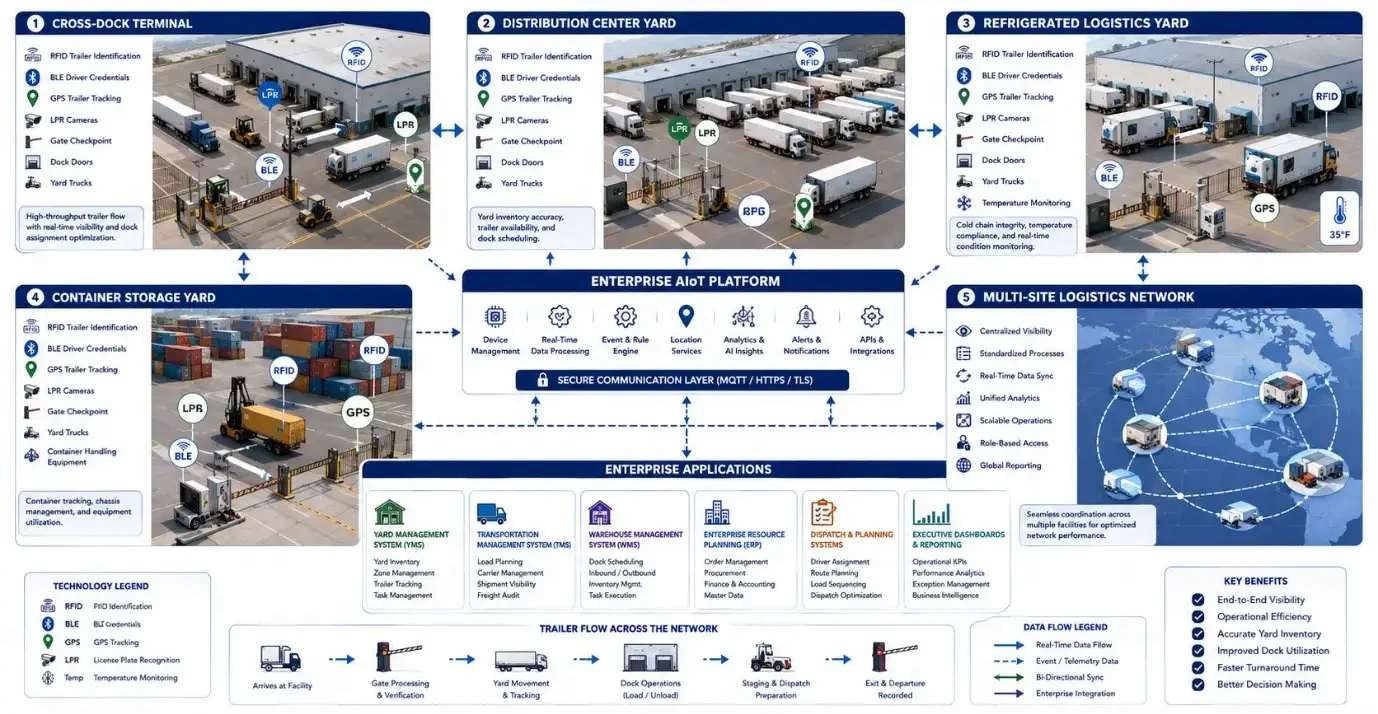
This enterprise illustration demonstrates how AI and IoT identification and location technologies support multiple yard management environments, including cross-dock terminals, distribution center yards, refrigerated logistics yards, container storage yards, and multi-site logistics networks. It shows RFID trailer identification, BLE driver credentials, GPS trailer tracking, license plate recognition, gate checkpoints, dock operations, yard trucks, and enterprise software integration working together to provide synchronized trailer movement, real-time visibility, and end-to-end operational intelligence.
Cross-Dock Yard Operations
Cross-dock facilities are designed to minimize storage time by rapidly transferring freight between inbound and outbound trailers. Yard efficiency directly affects dock utilization, transportation scheduling, shipment consolidation, and carrier performance. Even short delays at gate entry or trailer staging can disrupt outbound shipping schedules and increase congestion throughout the facility.
AI and IoT improves cross-dock yard operations by providing continuous visibility into trailer arrivals, staging locations, dock assignments, and departure readiness. Identification technologies enable automated recognition of trailers and authorized drivers as they enter the facility, reducing manual verification and accelerating gate throughput.
Operational Priorities for Cross-Dock Yards
Cross-dock environments typically focus on:
- Rapid trailer check-in
- Accurate trailer identification
- Dock door assignment
- Trailer staging optimization
- Yard truck dispatch coordination
- Empty trailer availability
- Carrier turnaround management
- Shipment transfer visibility
- Departure scheduling
- Gate security verification
These operational priorities help reduce idle trailer time while supporting higher trailer throughput across busy logistics facilities.
AI and IoT Deployment in Cross-Dock Facilities
Typical technologies deployed include RFID trailer tags for automated identification at gate lanes, BLE credentials for driver authentication, GPS trailer trackers for real-time location updates, and license plate recognition systems that validate vehicle information before entry. Edge AI processing supports immediate decision-making at gate checkpoints, allowing verified events to be synchronized with TMS and WMS software.
Because cross-dock facilities often process hundreds or thousands of trailer movements daily, automated identification significantly improves operational consistency while reducing manual administrative tasks.
Distribution Center Yard Management
Distribution center yards coordinate inbound supplier deliveries, outbound customer shipments, trailer staging, dock scheduling, and equipment utilization. Unlike cross-dock facilities, distribution centers frequently manage larger trailer inventories, longer dwell times, and multiple warehouse operations simultaneously.
AI and IoT supports continuous trailer visibility throughout these facilities by connecting gate activities, trailer locations, inventory records, and transportation workflows into a synchronized operational system.
Managing High Trailer Volumes
Distribution center operations commonly involve:
- Supplier deliveries
- Retail shipments
- Manufacturing support trailers
- Empty trailer pools
- Drop-and-hook operations
- Dedicated fleet trailers
- Carrier appointments
- Overflow parking
- Seasonal trailer staging
- Return logistics
Maintaining accurate trailer identification across these activities improves operational planning and reduces time spent searching for equipment.
Improving Yard Utilization
AI-assisted analytics help logistics teams evaluate trailer utilization by analyzing verified operational events generated throughout the yard. Organizations can identify underutilized parking areas, frequently congested gate lanes, recurring trailer bottlenecks, and inefficient trailer movement patterns.
These insights support improvements in:
- Parking allocation
- Yard truck routing
- Dock scheduling
- Trailer prioritization
- Carrier coordination
- Labor planning
- Equipment utilization
- Operational reporting
Rather than relying on periodic manual yard checks, supervisors receive continuously updated operational information that supports faster and more informed decision-making.
Multi-Site Yard Visibility
Large logistics enterprises rarely operate a single trailer yard. Distribution networks often include multiple regional distribution centers, import yards, manufacturing facilities, cross dock terminals, return centers, and overflow trailer lots. Each location may use different operational procedures, carrier schedules, trailer allocation policies, and enterprise software.
AI and IoT helps organizations create consistent visibility across geographically distributed yard operations without requiring every facility to operate identically. Rather than replacing local procedures, the solution standardizes identification, location awareness, gate event recording, trailer movement history, and operational reporting across all participating locations.
Organizations operating nationwide trailer networks often need answers to operational questions such as:
- Which location currently has available empty trailers?
- Which facility is experiencing excessive trailer dwell times?
- Which gate processes create recurring congestion?
- Which carriers consistently exceed scheduled appointment windows?
- Which yard has available parking capacity?
- Which refrigerated trailers require immediate dispatch?
- Which facilities have excessive trailer relocation activity?
AI-assisted analytics combine identification events from RFID, BLE, GPS, cellular communications, license plate recognition, and transportation software to generate operational dashboards for regional logistics managers.
Common multi-site deployment objectives include:
- Standardized trailer identification
- Unified gate event records
- Enterprise trailer inventory visibility
- Carrier performance comparison
- Trailer utilization reporting
- Yard capacity optimization
- Driver visit history
- Regional operational benchmarking
- Cross-facility trailer transfers
- Centralized compliance reporting
Instead of manually collecting spreadsheets from individual facilities, organizations receive continuously synchronized operational information from every participating location.
Standardizing Identification Across Multiple Locations
Consistent identification standards are essential when trailers frequently move between facilities.
Every trailer, yard tractor, gate, parking position, driver credential, and shipment identifier should use standardized naming conventions throughout the enterprise.
Typical identification standards include:
- RFID trailer identifiers
- BLE asset identifiers
- Driver badge IDs
- Gate location IDs
- Parking space numbering
- Dock door identifiers
- Carrier codes
- Trailer classifications
- Facility identifiers
- Load status codes
Standardized identification significantly reduces reconciliation work between TMS, WMS, ERP, and yard management software.
Enterprise Operational Visibility
Regional transportation managers require information beyond individual yard performance.
Enterprise reporting typically includes:
- Total trailers by location
- Loaded versus empty trailers
- Average dwell time by facility
- Carrier arrival performance
- Gate processing duration
- Dock utilization
- Parking occupancy
- Yard truck productivity
- Appointment adherence
- Shipment movement history
AI-generated operational summaries allow management teams to prioritize improvements based on measurable operational performance rather than isolated observations.
Cross-Facility Trailer Optimization
Large fleets frequently relocate trailers between distribution centers.
AI and IoT software helps identify:
- Empty trailer surpluses
- Trailer shortages
- Equipment imbalances
- Seasonal utilization trends
- Regional demand shifts
- Available trailer pools
- Idle trailer inventories
Instead of purchasing additional equipment unnecessarily, organizations can often improve trailer utilization through better redistribution.
Integration Across Enterprise Software
Multi-site operations typically exchange information with numerous enterprise systems simultaneously.
Common integrations include:
- Transportation Management Systems
- Warehouse Management Systems
- Enterprise Resource Planning software
- Dock scheduling software
- Carrier management software
- Fleet management software
- Driver management software
- Security management systems
- Business analytics software
- Financial reporting systems
Because Yard Management AI was developed within Aperture Venture Studio with support from GAO, our implementation experience reflects practical enterprise deployments accumulated through thousands of IoT projects. This experience supports software integration strategies that accommodate diverse operational environments while maintaining data consistency across distributed trailer yard operations.
Facility-Specific Deployment Considerations
Every trailer yard operates differently depending on cargo type, carrier volume, available space, operational priorities, and regulatory requirements.
Successful AIoT implementations begin with understanding facility workflows before selecting identification technologies, communication methods, and software integrations.
High-Volume Distribution Centers
High-throughput distribution centers prioritize:
- Fast gate processing
- Trailer visibility
- Appointment management
- Dock scheduling
- Yard congestion reduction
- Empty trailer balancing
- Yard tractor optimization
These facilities typically benefit from extensive RFID gate identification combined with GPS trailer positioning and AI-assisted operational analytics.
Cross-Dock Facilities
Cross-dock operations emphasize:
- Minimal trailer dwell time
- Immediate dock assignments
- Accurate shipment traceability
- Rapid trailer exchanges
- Driver coordination
BLE proximity identification, RFID gate verification, and transportation software integration help maintain continuous trailer movement.
Refrigerated Facilities
Cold chain trailer yards generally require:
- Reefer trailer identification
- Power connection verification
- Temperature event association
- Product traceability
- Regulatory documentation
- Refrigerated asset prioritization
AI and IoT supports continuous identification of refrigerated equipment while integrating reefer operational data with transportation workflows.
Container Facilities
Container yards emphasize:
- Container positioning
- Equipment interchange
- Gate verification
- Container inventory
- Chassis allocation
- Crane coordination
GPS positioning, RFID identification, and AI-assisted movement analysis improve container visibility throughout terminal operations.
Mixed-Use Industrial Yards
Industrial campuses frequently combine:
- Manufacturing trailers
- Supplier deliveries
- Finished goods staging
- Employee parking
- Contractor access
- Visitor management
- Maintenance vehicles
- Equipment storage
These environments require flexible identification strategies capable of managing multiple asset categories within one operational system.
Applications Across Modern Yard Management Operations
AI and IoT supports numerous operational scenarios throughout modern trailer yards.
Typical deployment applications include:
- Trailer arrival verification
- Automated gate processing
- Driver identification
- Visitor authorization
- Contractor access management
- Trailer inventory visibility
- Empty trailer management
- Loaded trailer prioritization
- Yard truck coordination
- Dock assignment support
- Appointment verification
- Carrier performance reporting
- Trailer dwell analytics
- Parking utilization
- Shipment traceability
- Cross-facility asset visibility
- Container positioning
- Refrigerated trailer management
- Fleet utilization reporting
- Enterprise operational analytics
Each implementation can be tailored to existing operational procedures while preserving compatibility with enterprise transportation and warehouse software.
Practical Considerations Before Deployment
Organizations planning AI-enabled yard management projects should evaluate several operational factors before implementation.
Important planning considerations include:
- Facility size and layout
- Trailer population
- Daily gate transaction volume
- Carrier diversity
- Existing TMS and WMS software
- ERP integration requirements
- Wireless communication coverage
- Trailer identification methods
- Security requirements
- Compliance obligations
- Future expansion plans
- Multi-site reporting objectives
Early operational assessments help determine appropriate combinations of RFID, BLE, GPS, cellular communications, edge processing, and enterprise software integration.
Organizations also benefit from phased deployments that validate operational improvements before expanding across additional facilities.
Advancing Operational Excellence Across Every Yard Environment
Modern trailer yard operations demand more than isolated gate automation or trailer tracking. Distribution centers, cross-dock facilities, refrigerated yards, container terminals, and multi-site logistics networks require connected identification, reliable location visibility, synchronized enterprise software, and operational analytics that support faster decisions throughout daily yard activities.
Yard Management AI applies AI and IoT technologies to improve people identification, access control, trailer visibility, inventory accuracy, shipment traceability, and enterprise-wide coordination across diverse yard environments. Backed by two decades of GAO experience in IoT solutions, extensive investments in research and quality assurance, and support from experienced technical specialists, our solutions are designed to help logistics organizations modernize yard operations while integrating smoothly with existing transportation, warehouse, and enterprise management systems.