Brief Description of Applications
Brief Description of Applications
Modern trailer yards depend on accurate identification, reliable asset visibility, and coordinated operational workflows. Yard Management AI delivers enterprise IoT software that connects RFID trailer tags, BLE credentials, GPS trackers, license plate recognition systems, cellular devices, and edge computing equipment into a unified software environment.
The software supports distribution centers, regional freight hubs, manufacturing shipping yards, container terminals, cross-dock facilities, and cold chain operations by providing continuous communication between field devices and enterprise business systems. Rather than replacing Transportation Management Systems (TMS) or Warehouse Management Systems (WMS), the IoT software supplies trusted identification, location, and operational event data that enables those systems to operate with greater accuracy.
Organizations can improve trailer visibility, automate gate processing, maintain accurate yard inventories, coordinate shipment movement, and simplify device administration while supporting large-scale trailer yard deployments.
IoT Software for Modern Trailer Yard Operations
Trailer yards generate thousands of operational events every day. Drivers arrive at entry gates, trailers are identified, yard tractors relocate equipment, dock assignments change throughout the day, and outbound shipments continuously move toward transportation networks. Each of these events depends on accurate identification and reliable communication between connected field devices and enterprise software.
IoT software serves as the communication layer that manages these connected devices while delivering verified operational data to yard management software and enterprise logistics applications. Rather than focusing on business analytics, the software is responsible for collecting identification events, validating device communications, managing connected hardware, synchronizing operational records, and maintaining reliable information flow across the yard.
Within trailer yard operations, the software commonly manages:
- RFID trailer identification
- BLE personnel credentials
- Driver identification
- License plate recognition events
- GPS trailer positioning
- Yard truck location updates
- Cellular communication devices
- Edge computing equipment
- Device health monitoring
- Operational event synchronization
Because distribution yards often operate around the clock, communication reliability becomes critical. Temporary communication interruptions, duplicate identification events, or incomplete operational records can quickly affect gate throughput, trailer visibility, and transportation scheduling.
Yard Management AI is designed to provide dependable communication between field hardware and enterprise software while supporting continuous trailer movement across high-volume logistics facilities.
Enterprise IoT Software Data Flow for Trailer Yard Operations
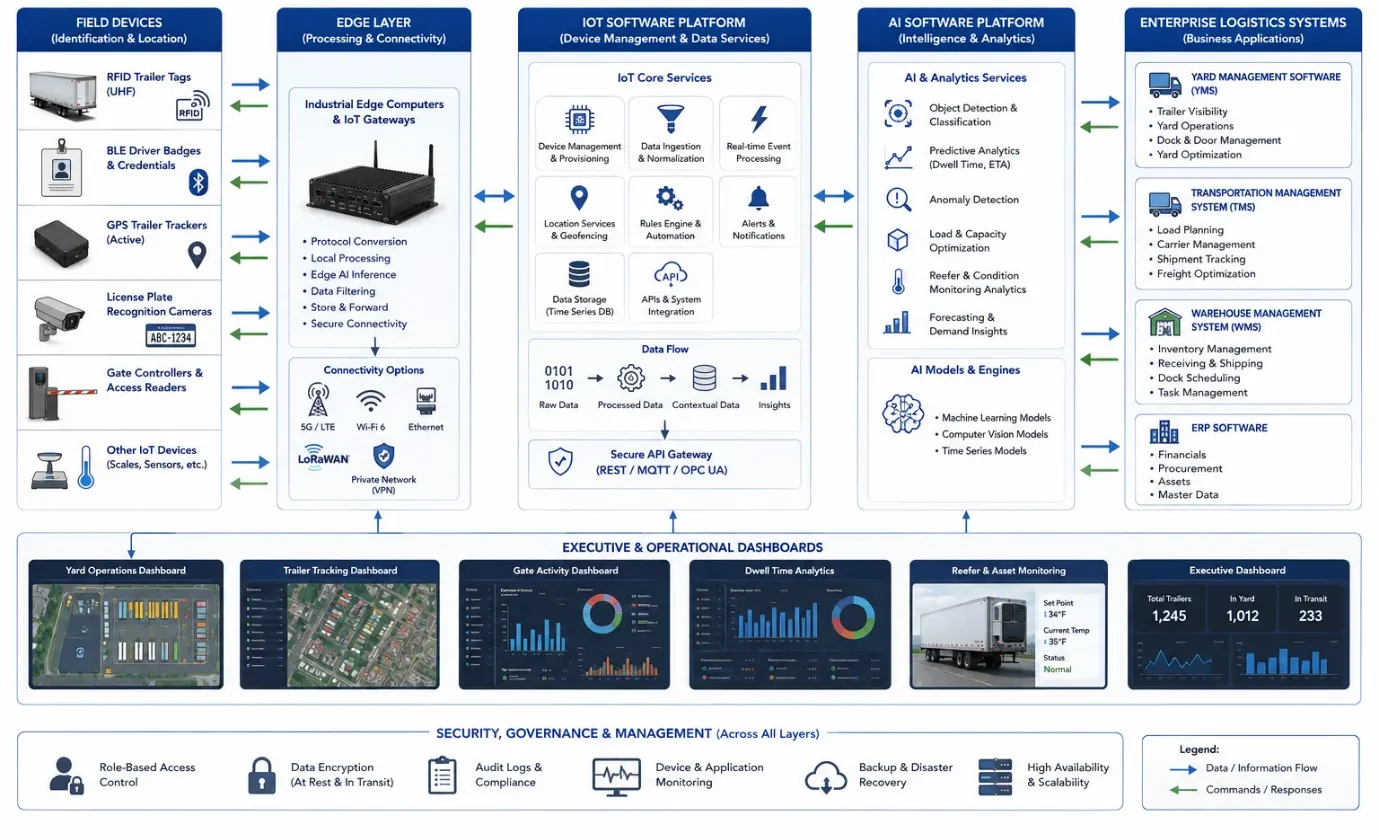
This enterprise software data flow diagram illustrates how identification and location technologies—including RFID trailer tags, BLE driver badges, GPS trailer trackers, license plate recognition cameras, and gate controllers—connect through industrial edge computers, IoT software, and AI software to Yard Management Software (YMS), Transportation Management Systems (TMS), Warehouse Management Systems (WMS), ERP platforms, and executive dashboards. It highlights bidirectional information flow that enables real-time trailer visibility, operational automation, and enterprise-wide logistics intelligence.
Gate Access Software
Gate operations establish the first verified operational record for every arriving or departing trailer. Efficient gate processing helps reduce vehicle queues, improves carrier scheduling, minimizes manual paperwork, and provides reliable operational records for downstream logistics activities.
Gate Access Software coordinates communication between identification devices, gate hardware, driver credentials, trailer records, and enterprise logistics systems. The software validates operational events before they become part of the official yard record, helping organizations maintain accurate information throughout daily operations.
Typical gate functions supported include:
- Driver identification
- Carrier verification
- Trailer identification
- License plate matching
- Entry authorization
- Exit authorization
- Visitor processing
- Contractor access
- Operational logging
- Event synchronization
Because every trailer entering or leaving the yard passes through gate operations, reliable software directly influences overall yard efficiency.
Gate Access Control Software
Gate Access Control Software manages communication between gate hardware and enterprise business systems to ensure that authorized personnel, trailers, and transportation assets enter or leave the facility according to operational policies.
The software receives identification events from connected technologies such as RFID gate read points, BLE credentials, license plate recognition cameras, and gate controllers. Each event is validated before operational records are updated and shared with yard management applications.
Key operational responsibilities include:
- Driver identity verification
- Trailer authorization
- Carrier validation
- Appointment confirmation
- Entry and exit event recording
- Automated gate transactions
- Visitor authorization
- Security event documentation
Rather than relying on manual gate logs, personnel receive verified operational information that supports faster processing and improved record accuracy.
Operational benefits include:
- Reduced vehicle queues
- Faster gate throughput
- Improved security compliance
- Accurate operational records
- Fewer manual data entry errors
- Better transportation coordination
- Improved audit readiness
- Consistent gate procedures
The software also maintains detailed historical records that support operational reporting, compliance reviews, and transportation performance analysis.
Driver Credential Management Software
Drivers, contractors, maintenance personnel, inspectors, and visitors require different access permissions depending on their operational responsibilities. Driver Credential Management Software centralizes credential administration while supporting secure identification throughout the trailer yard.
The software maintains digital records associated with:
- Driver credentials
- Carrier affiliations
- Vehicle assignments
- Trailer authorizations
- Contractor permissions
- Visitor registrations
- Temporary access approvals
- Operational certifications
Credential information is validated whenever personnel interact with gate access systems, helping reduce manual verification while maintaining secure operational procedures.
Additional software capabilities include:
- Credential lifecycle management
- Expiration tracking
- Access policy administration
- Multi-site credential synchronization
- Contractor access management
- Audit history
- Security reporting
- Exception management
These capabilities improve operational efficiency while helping organizations maintain controlled access across large logistics facilities with multiple entry points and high daily traffic volumes.
Gate Access Software Workflow for Driver Credential Management
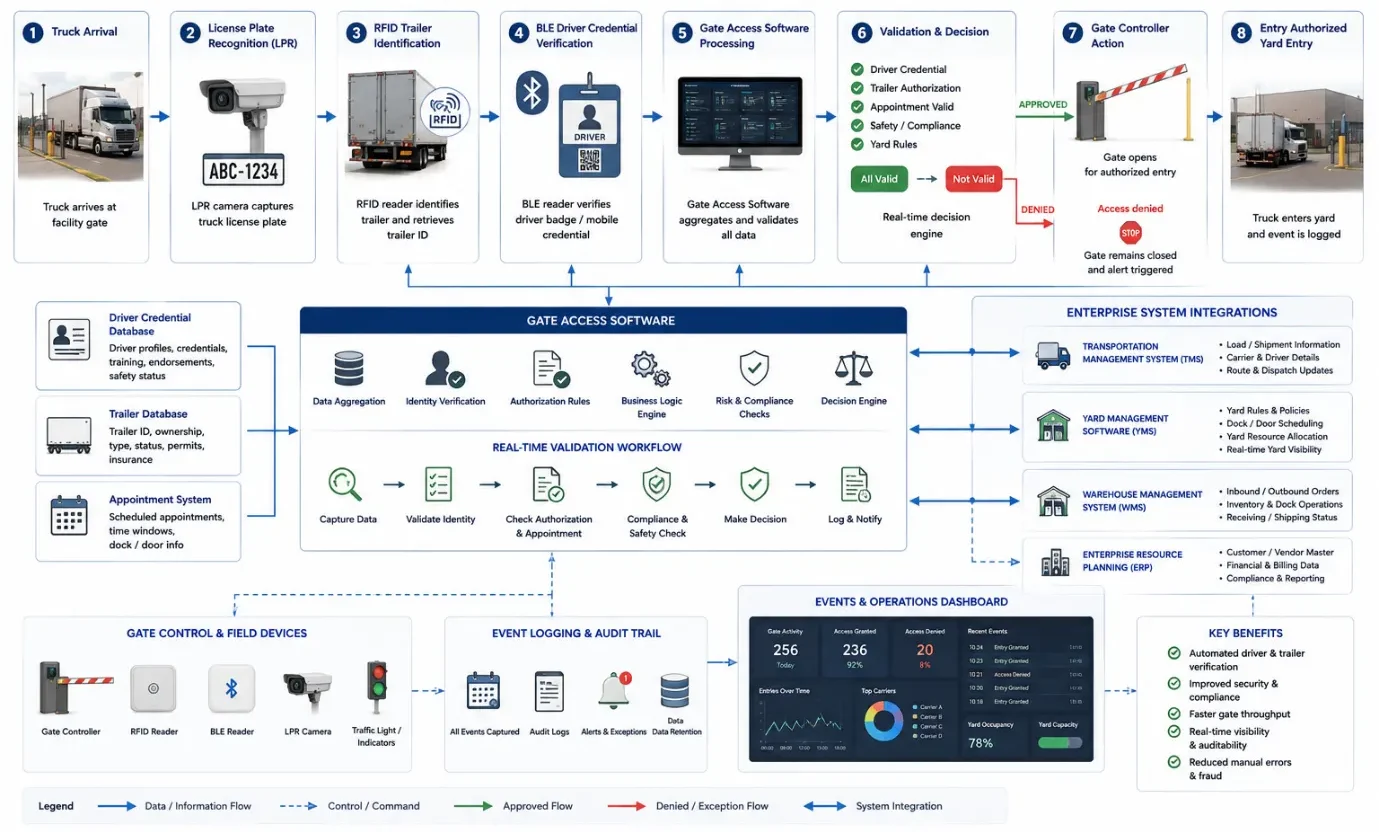
This workflow diagram illustrates how Gate Access Software manages secure trailer yard entry by verifying driver credentials, validating appointments, identifying trailers with RFID, recognizing license plates, and authorizing gate access. It also shows integration with Transportation Management Systems (TMS), Yard Management Software (YMS), driver credential databases, gate controllers, and event logging dashboards to provide automated access control, compliance, and complete audit visibility.
Trailer Tracking Software
Efficient trailer yard operations depend on knowing where every trailer is located, how it is being used, and whether operational records accurately reflect actual yard conditions. Trailer Tracking Software serves as the communication layer between identification devices and enterprise applications, ensuring that trailer location updates, movement events, and inventory changes are consistently synchronized.
Rather than performing business analysis, the software continuously receives identification events from connected hardware, validates those events, and updates trailer records in real time. This enables yard personnel, dispatchers, warehouse operators, and transportation planners to work from the same operational information.
The software supports:
- Trailer identification
- Trailer location updates
- Yard inventory synchronization
- Parking zone management
- Yard truck movement records
- Trailer assignment coordination
- Dock status updates
- Historical movement records
Large distribution campuses, manufacturing shipping yards, container terminals, and cross-dock facilities benefit from a continuously updated operational record that reduces manual yard inspections and improves trailer availability.
Trailer Location Software
Trailer Location Software maintains verified location records for trailers as they move throughout the yard. Every identification event generated by RFID, BLE, GPS, license plate recognition, or edge computing devices is processed and associated with the appropriate trailer record.
The software supports operational activities such as:
- Trailer arrival registration
- Parking location assignment
- Dock movement updates
- Yard tractor relocation
- Outbound staging
- Exit confirmation
- Trailer search
- Multi-zone yard visibility
Location records remain synchronized with enterprise software so transportation coordinators, dispatchers, warehouse supervisors, and security personnel all reference the same operational information.
Instead of relying on manual radio communication or physical trailer searches, personnel can quickly determine trailer status through continuously updated software records.
Operational benefits include:
- Reduced trailer search time
- Faster dock assignments
- Improved yard traffic flow
- Better trailer utilization
- Increased transportation efficiency
- Reduced manual communication
- Improved operational accuracy
- Faster shipment preparation
Historical location records also support operational audits, transportation reporting, and continuous process improvement.
Yard Inventory Management Software
Accurate trailer inventory forms the foundation of efficient yard management. Distribution facilities often manage hundreds or thousands of trailers that continuously arrive, depart, relocate, and exchange dock assignments throughout the day.
Yard Inventory Management Software maintains a continuously updated inventory by synchronizing trailer identification events with enterprise operational records.
The software tracks:
- Empty trailers
- Loaded trailers
- Assigned trailers
- Available trailers
- Carrier-owned equipment
- Customer-owned trailers
- Reserved parking locations
- Dock assignments
Inventory synchronization occurs automatically whenever trailer identification events are received, reducing discrepancies between physical yard conditions and enterprise records.
Operations personnel benefit from current inventory information when planning:
- Dock scheduling
- Trailer assignments
- Carrier coordination
- Outbound shipments
- Equipment utilization
- Yard balancing
- Trailer availability
- Transportation planning
Maintaining accurate inventory records also improves collaboration between transportation operations and warehouse logistics by ensuring both departments operate using the same verified information.
Trailer Tracking Software Workflow for Enterprise Yard Operations
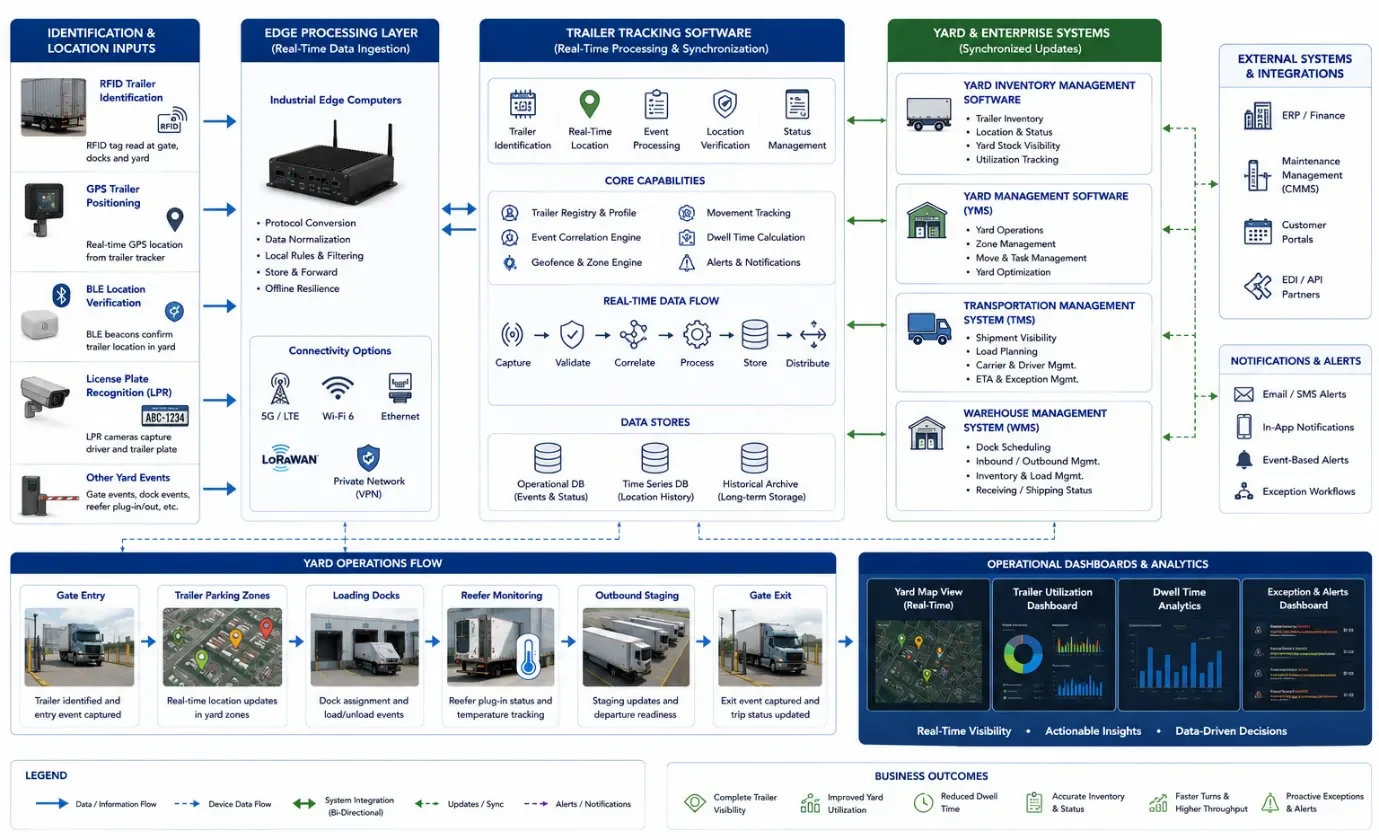
This enterprise workflow diagram illustrates how Trailer Tracking Software continuously synchronizes trailer identification and location data with enterprise logistics systems. It shows RFID trailer identification, GPS positioning, BLE location verification, license plate recognition, industrial edge computing, and real-time data flow into Yard Inventory Management Software, Yard Management Software (YMS), Transportation Management Systems (TMS), Warehouse Management Systems (WMS), trailer parking zones, loading docks, outbound staging, and operational dashboards to provide complete trailer visibility and operational coordination.
Load and Cold Chain Software
Distribution yard operations frequently involve coordinating shipments with varying operational requirements. While many trailers transport standard freight, others support refrigerated products, pharmaceuticals, food products, biotechnology materials, and temperature-controlled cargo.
Load and Cold Chain Software helps maintain accurate operational records for shipment progression while coordinating trailer activities associated with refrigerated logistics. The software focuses on identification, communication, and operational synchronization rather than environmental sensing.
Operational capabilities include:
- Shipment identification
- Load status management
- Trailer assignment
- Operational milestone recording
- Reefer trailer coordination
- Distribution scheduling
- Outbound shipment management
- Historical shipment records
These capabilities improve visibility across distribution centers, cross-dock operations, manufacturing logistics, and refrigerated freight networks.
Load Status Tracking Software
Load Status Tracking Software records operational milestones as shipments progress through trailer yard workflows.
Typical operational events include:
- Arrival confirmation
- Gate processing
- Trailer assignment
- Dock assignment
- Loading initiation
- Loading completion
- Documentation verification
- Shipment release
- Departure confirmation
Each event becomes part of a complete operational history that can be shared with Transportation Management Systems, Warehouse Management Systems, and enterprise reporting applications.
Maintaining accurate shipment records helps organizations improve:
- Transportation planning
- Carrier communication
- Shipment coordination
- Dock scheduling
- Operational reporting
- Compliance documentation
- Customer service
- Freight visibility
Because operational records are generated automatically from verified identification events, manual status updates become significantly less frequent.
Reefer Monitoring Software
Facilities handling refrigerated freight require specialized operational coordination to ensure refrigerated trailers move efficiently through the yard. Reefer Monitoring Software maintains communication with connected refrigeration equipment while coordinating trailer identification and operational workflows.
The software supports:
- Reefer trailer identification
- Refrigerated trailer assignment
- Dock scheduling
- Trailer movement coordination
- Operational status reporting
- Cellular communication management
- Fleet visibility
- Historical operational records
Rather than functioning as an environmental monitoring application, the software focuses on maintaining reliable operational communication between refrigerated trailer equipment and enterprise logistics software.
This approach helps logistics organizations coordinate refrigerated freight movement while maintaining accurate operational records across temperature-controlled distribution facilities.
The Role of IoT Software Versus AI Software in the Yard Technology Stack
Although IoT software and AI software work together, they perform different functions within trailer yard operations. Understanding this distinction helps IT teams, logistics managers, and system integrators design scalable yard management solutions that support both operational reliability and data-driven decision-making.
IoT software is responsible for connecting field devices, managing communications, validating identification events, synchronizing operational records, and exchanging information with enterprise business systems. AI software builds upon this trusted operational data by analyzing workflows, recognizing operational patterns, identifying exceptions, and supporting operational optimization.
Within a modern trailer yard, IoT software typically manages:
- Device communication
- RFID reader management
- BLE credential communication
- GPS tracker connectivity
- Cellular device communication
- License plate recognition integration
- Device configuration
- Operational event synchronization
- Edge computing coordination
- Enterprise data exchange
AI software uses these verified operational records to support functions such as:
- Gate access verification
- Trailer location analytics
- Yard asset utilization analysis
- Trailer dwell time evaluation
- Shipment progression analysis
- Operational exception detection
- Yard performance reporting
- Decision support for logistics teams
This separation of responsibilities improves system reliability, simplifies maintenance, and allows organizations to scale connected yard operations without disrupting enterprise business applications.
Data Flow from Gate and Trailer Devices to Yard Management Software
Reliable trailer yard operations depend on accurate and timely information exchange between identification devices and enterprise applications. Every operational event generated within the yard follows a structured communication workflow that transforms raw identification data into verified business records.
A typical information flow includes:
- Driver arrives at the entry gate.
- RFID, BLE, GPS, or license plate recognition devices identify the driver, trailer, or vehicle.
- Edge computing equipment validates and processes identification events.
- IoT software receives, verifies, and timestamps operational records.
- Verified information is synchronized with Yard Management Software.
- Transportation Management Systems and Warehouse Management Systems receive updated operational data.
- AI software analyzes operational trends and identifies optimization opportunities.
- Dashboards present current yard activity to operations personnel.
This structured workflow ensures that trailer movements, gate transactions, inventory updates, and shipment progression remain synchronized across multiple enterprise systems.
Reliable data flow supports:
- Faster gate processing
- Accurate trailer inventories
- Improved shipment coordination
- Better dock scheduling
- Reduced duplicate records
- Consistent operational reporting
- Improved transportation planning
- Greater enterprise visibility
Organizations operating multiple distribution centers also benefit from standardized communication procedures across geographically distributed facilities.
Enterprise Data Flow from Gate and Trailer Devices to Logistics Systems
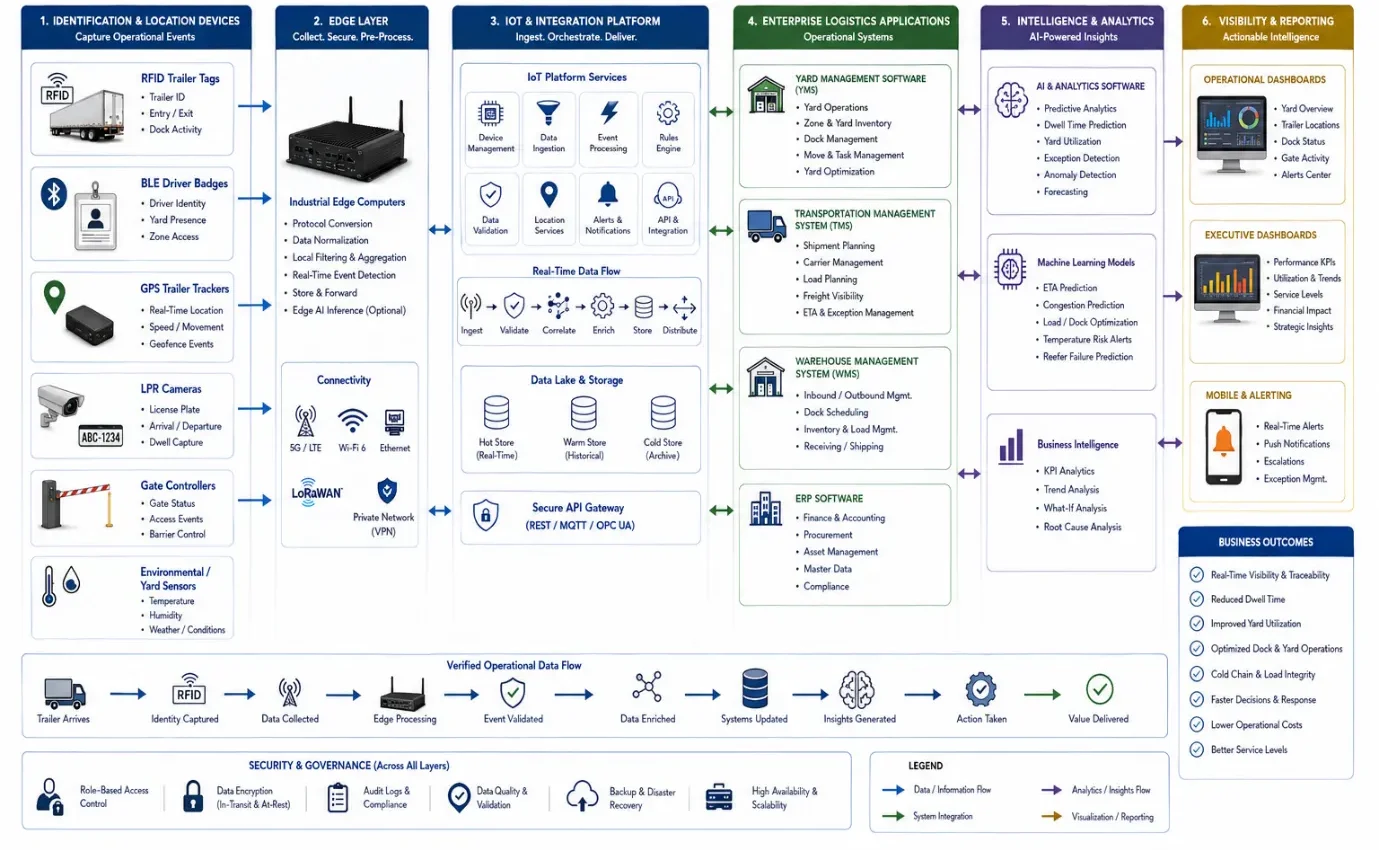
This enterprise data flow diagram illustrates how verified operational data moves from RFID trailer tags, BLE driver badges, GPS trailer trackers, license plate recognition cameras, and industrial edge computers through IoT software into Yard Management Software (YMS), Transportation Management Systems (TMS), Warehouse Management Systems (WMS), ERP platforms, AI analytics software, operational dashboards, and executive reporting systems. It demonstrates end-to-end information flow that enables real-time visibility, enterprise integration, and intelligent logistics decision-making across trailer yard operations.
Compatibility with RFID, BLE, GPS, and Cellular Hardware
Distribution yard environments rarely rely on a single identification technology. Different operational workflows require different communication methods depending on trailer movement, gate processing, personnel identification, fleet management, and refrigerated freight operations.
Yard Management AI is designed to support enterprise deployments using multiple identification and communication technologies within the same operational environment.
Supported technologies include:
RFID Integration
RFID supports rapid trailer identification at gate lanes, dock entrances, and designated yard checkpoints.
Typical RFID applications include:
- Trailer identification
- Gate read points
- Automatic trailer registration
- Dock arrival confirmation
- Inventory verification
BLE Integration
BLE supports secure identification of personnel and authorized drivers while enabling proximity-based operational workflows.
Typical BLE applications include:
- Driver credentials
- Personnel identification
- Visitor management
- Contractor verification
- Secure access authorization
GPS Integration
GPS provides location awareness for trailers, yard tractors, and transportation assets operating across large logistics campuses.
Common GPS applications include:
- Trailer positioning
- Yard truck tracking
- Fleet coordination
- Multi-site visibility
- Transportation reporting
Cellular Communication
Cellular connectivity supports mobile assets operating beyond local wireless coverage while maintaining communication with enterprise logistics systems.
Typical applications include:
- Trailer communications
- Reefer operational connectivity
- Remote fleet reporting
- Mobile equipment communication
- Wide-area logistics operations
Because these technologies complement one another, organizations can deploy the most appropriate identification method for each operational workflow while maintaining centralized software administration.
Why Organizations Choose Yard Management AI
Successful trailer yard software deployments require more than reliable device connectivity. Organizations also need experienced implementation teams, proven industrial expertise, and long-term technical support capable of supporting complex logistics operations.
Yard Management AI was created within Aperture Venture Studio with support from GAO. Drawing on more than two decades of IoT experience, the organization has supported thousands of customers and successfully completed thousands of industrial logistics and supply chain projects. This practical experience has guided continued investment in research and development, rigorous quality assurance processes, and comprehensive technical support delivered remotely or on-site.
Led by Ph.D. professionals and supported by experienced engineers and strategic partners, Yard Management AI has contributed to projects serving Fortune 500 manufacturers, major logistics organizations, leading research institutions, prestigious universities, and government agencies throughout the United States and Canada.
This combination of technical expertise and real-world deployment experience enables organizations to implement reliable IoT software for gate operations, trailer visibility, enterprise integration, and large-scale yard management.
Modernizing Distribution Yard Software with AI and IoT
Efficient trailer yard operations depend on accurate identification, reliable communication, and synchronized operational records. IoT software forms the operational foundation that connects field devices with enterprise business systems, ensuring that gate events, trailer movements, yard inventories, and shipment records remain consistent across the organization.
By supporting RFID, BLE, GPS, cellular communications, edge computing, and enterprise software integration, Yard Management AI enables logistics organizations to improve gate throughput, maintain accurate trailer visibility, strengthen inventory accuracy, and support coordinated transportation workflows across modern distribution yard environments. This connected software approach helps organizations increase operational efficiency while providing the trusted data required for advanced AI-driven analysis and continuous operational improvement.