Connecting Gate, Trailer, and Yard Systems Across Modern Terminal Operations
Modern yard management depends on accurate, continuous data exchange between gate operations, trailer movement, warehouse activities, transportation planning, and enterprise business software. Trailer arrivals, departures, dock assignments, gate verification, yard truck dispatching, trailer positioning, and inventory availability all generate operational events that must be synchronized across multiple business systems.
AI and IoT enables organizations to connect identification technologies such as RFID, BLE, GPS, cellular communication, license plate recognition, and edge computing with Transportation Management Systems (TMS), Warehouse Management Systems (WMS), Enterprise Resource Planning (ERP), and yard management software. Rather than operating as isolated systems, these technologies work together to maintain a continuously updated operational view of trailers, drivers, gate activities, yard assets, and freight movement.
Yard Management AI develops enterprise integration solutions specifically designed for industrial logistics and supply chain organizations managing complex trailer yards, distribution campuses, manufacturing facilities, cross-dock operations, intermodal facilities, and regional logistics hubs. The objective is not simply collecting data but ensuring the right operational information reaches the appropriate business system with minimal delay.
Organizations operating high-volume trailer yards often require integration between multiple software environments including transportation scheduling, warehouse execution, appointment management, dock scheduling, dispatch systems, billing applications, security systems, and reporting tools. AIoT provides the identification layer that continuously updates these business applications using verified operational events generated throughout the yard.
Applications Across Yard Management
System integration supports numerous operational activities throughout trailer yard environments.
Typical applications include:
- Trailer check-in and check-out automation
- Driver credential verification
- Gate lane automation
- Dock door assignment synchronization
- Trailer inventory visibility
- Yard truck dispatch coordination
- Empty trailer management
- Loaded trailer prioritization
- Trailer dwell time analysis
- Cross-dock coordination
- Manufacturing yard logistics
- Distribution center operations
- Container staging
- Fleet yard management
- Multi-site logistics coordination
- Cold chain trailer visibility
- Shipment traceability
- Carrier appointment management
- Gate security auditing
- Enterprise logistics reporting
These integration capabilities allow organizations to reduce manual data entry while improving operational consistency throughout yard operations.
Enterprise AIoT Integration for Terminal Yard Operations
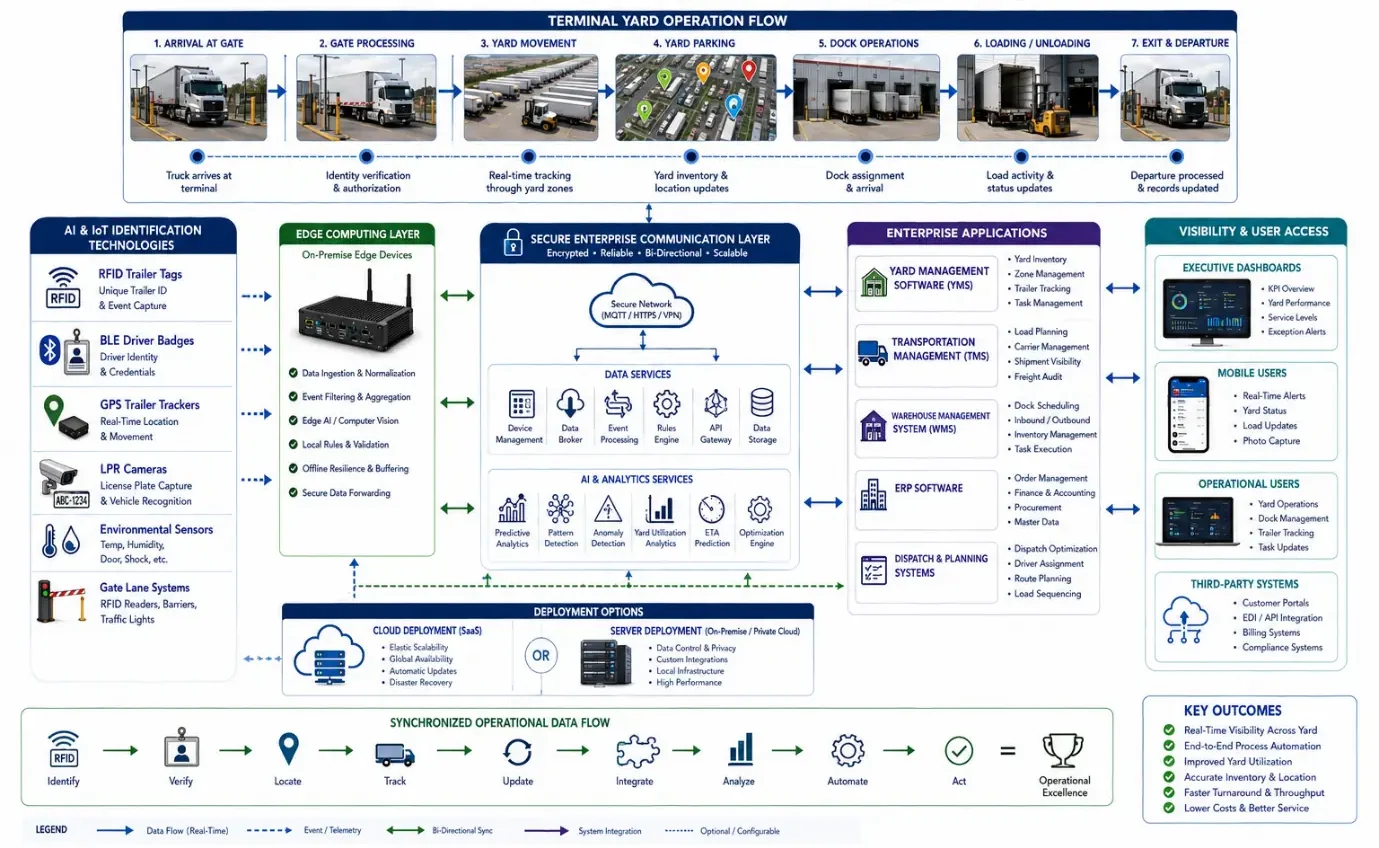
This enterprise integration diagram illustrates how AI and IoT identification technologies exchange operational data across a modern terminal yard. It shows RFID trailer identification, BLE driver credentials, GPS trailer tracking, license plate recognition, and edge computing integrated with Yard Management Software (YMS), Transportation Management Systems (TMS), Warehouse Management Systems (WMS), ERP, dispatch systems, cloud and server deployments, executive dashboards, and mobile users to deliver synchronized, real-time visibility from gate entry through dock operations to facility departure.
TMS Integration for Yard Operations
Transportation Management Systems coordinate freight planning, carrier scheduling, shipment execution, and transportation visibility. Yard operations continuously generate transportation events that directly affect shipment planning.
AI and IoT integration enables verified operational events to automatically update TMS software without relying solely on manual operator input.
Gate Arrival Synchronization
When trailers arrive at the facility, identification technologies automatically associate the arriving equipment with scheduled transportation records.
Typical events include:
- Carrier arrival
- Trailer arrival
- Driver verification
- Gate lane assignment
- Appointment confirmation
- Trailer number verification
- Arrival timestamp
- Gate authorization
- Security validation
These events become immediately available inside transportation workflows.
Trailer Movement Updates
As trailers move between staging areas, parking locations, inspection zones, maintenance areas, and dock positions, location updates continue flowing into transportation software.
Operational updates may include:
- Trailer relocation
- Dock assignment
- Yard truck movement
- Loaded trailer availability
- Empty trailer availability
- Shipping readiness
- Dispatch preparation
- Departure authorization
This allows transportation planners to work from continuously updated operational information.
Carrier Performance Reporting
Integrated yard data also supports transportation analytics.
Organizations frequently evaluate:
- Average gate processing time
- Appointment compliance
- Trailer dwell duration
- Carrier turnaround time
- Dock utilization
- Yard congestion
- Loading efficiency
- Dispatch performance
AI-assisted analytics can identify recurring transportation bottlenecks that affect overall logistics performance.
WMS Integration for Distribution Yard Operations
Warehouse Management Systems coordinate inventory movement inside warehouse facilities. Yard activities directly influence warehouse scheduling because trailers represent inbound inventory, outbound shipments, returns, empty equipment, and staging operations.
AI and IoT integration creates synchronized communication between trailer yards and warehouse execution software.
Dock Door Coordination
Warehouse teams require accurate knowledge regarding arriving trailers before unloading begins.
Integrated information may include:
- Trailer identification
- Assigned dock door
- Arrival confirmation
- Estimated unloading time
- Driver status
- Shipment priority
- Yard location
- Queue position
Warehouse personnel receive current operational information without manually contacting gate operators.
Yard Inventory Synchronization
Trailer inventory represents an extension of warehouse inventory.
Integration supports:
- Loaded trailer inventory
- Empty trailer inventory
- Reserved trailer locations
- Trailer availability
- Temporary storage
- Cross-dock staging
- Shipment consolidation
- Trailer allocation
This improves inventory accuracy while reducing unnecessary trailer searches.
Shipping Coordination
Outbound shipping operations benefit from synchronized trailer status updates.
Warehouse personnel can determine whether trailers are:
- Ready for loading
- Currently loading
- Awaiting inspection
- Cleared for departure
- Awaiting carrier
- Dispatched
- Delayed
- Reassigned
Continuous synchronization minimizes communication delays between warehouse and yard personnel.
Enterprise Resource Planning Software Integration
Many organizations integrate AI and IoT yard operations with Enterprise Resource Planning software.
ERP integration allows operational events to support broader business functions including:
- Shipping confirmation
- Inventory accounting
- Asset utilization
- Equipment maintenance scheduling
- Customer order processing
- Fleet reporting
- Financial reconciliation
- Operational auditing
Verified identification data improves enterprise record accuracy by reducing duplicate manual entries.
Standard Enterprise Integration Interfaces
Successful integration depends upon standardized communication between software systems.
Common enterprise interfaces include:
- REST APIs
- SOAP Web Services
- MQTT
- OPC UA
- XML
- JSON
- HTTPS
- Secure VPN communication
- Microsoft SQL databases
- Oracle databases
- PostgreSQL databases
These communication methods allow yard management software to exchange operational information with existing enterprise applications while preserving cybersecurity policies.
Flexible Data Exchange Between Operational Systems
Different organizations require different integration strategies depending on existing software investments.
Yard Management AI supports integration with:
- Transportation Management Software
- Warehouse Management Software
- Enterprise Resource Planning Software
- Fleet Management Software
- Dispatch Software
- Appointment Scheduling Software
- Security Management Software
- Visitor Management Software
- Maintenance Management Software
- Business Analytics Software
- Mobile Workforce Applications
- Executive Reporting Systems
This flexibility allows organizations to modernize yard operations without replacing existing enterprise software.
Deployment Models for AI and IoT Terminal Yard Operations
Selecting the appropriate deployment model is a strategic decision that affects scalability, cybersecurity, data ownership, system availability, disaster recovery, and long-term maintenance. Yard management environments differ significantly depending on whether they support a single manufacturing facility, a regional distribution center, a container yard, or a nationwide logistics network. For this reason, Yard Management AI supports multiple deployment options that align with enterprise IT policies and operational requirements.
Rather than adopting a one-size-fits-all approach, organizations can choose cloud-based deployment, server-based deployment, or a hybrid model that combines centralized management with local processing for critical gate and yard operations.
Cloud Yard Management Software
Cloud deployment provides centralized management for organizations operating multiple facilities or geographically distributed yard locations. Authorized users can securely access operational information from corporate offices, logistics control centers, or regional management teams without requiring direct access to local servers.
Common advantages include:
- Centralized software administration
- Simplified software updates
- Multi-site visibility
- Consolidated reporting
- Remote operational oversight
- Flexible storage expansion
- Business continuity support
- Secure user authentication
- Enterprise role-based access control
- Reduced local infrastructure requirements
Cloud deployment is particularly suitable for organizations managing multiple distribution centers, manufacturing campuses, cross-dock facilities, regional transportation hubs, or nationwide trailer networks where operational consistency is a priority.
Server-Based Yard Management Software
Some organizations require complete control over operational data and system infrastructure. Server-based deployment keeps application software and databases within the organization's own IT environment, supporting internal governance, cybersecurity policies, and regulatory compliance.
Typical reasons for selecting server deployment include:
- Corporate data governance requirements
- Internal cybersecurity policies
- Limited external network connectivity
- Manufacturing security standards
- Government or defense operational requirements
- Low-latency processing
- Existing enterprise server investments
- Customized software integration
This deployment model is commonly selected by organizations that require strict operational control while maintaining integration with transportation, warehouse, and enterprise business software.
Hybrid Deployment Models
Many organizations combine cloud and server resources to balance operational responsiveness with enterprise-wide visibility.
A hybrid implementation may include:
- Local edge processing for gate operations
- On-premises databases for operational continuity
- Cloud reporting for executive dashboards
- Centralized user management
- Local event buffering during network interruptions
- Secure synchronization between facilities
- Regional data aggregation
- Enterprise-wide analytics
Hybrid deployment helps maintain uninterrupted gate operations while still providing consolidated reporting across multiple locations.
Edge Processing for Gate Events
Gate lanes represent one of the busiest operational areas within a trailer yard. Decisions regarding vehicle authorization, trailer identification, driver validation, and access control often need to occur within seconds. Sending every identification event to a remote data center before making a decision can introduce unnecessary latency.
Edge processing places computing resources closer to the operational point where identification events occur. This allows important business rules to be evaluated locally before synchronizing verified data with enterprise software.
Local Processing for Faster Decisions
Edge computing devices installed near gate infrastructure can process identification events generated by RFID readers, BLE credentials, GPS trackers, and license plate recognition systems. This enables immediate operational responses without waiting for centralized processing.
Examples of locally processed activities include:
- Gate authorization
- Driver credential verification
- Trailer identification matching
- Lane assignment
- Barrier control
- Visitor validation
- Security policy enforcement
- Exception handling
Processing these events locally helps maintain smooth vehicle flow even during periods of heavy traffic.
Business Continuity During Network Interruptions
Terminal yards cannot stop operating because of temporary communication disruptions. Edge processing allows critical identification activities to continue even if external connectivity is temporarily unavailable.
Operational capabilities during communication outages may include:
- Local credential verification
- Trailer identification
- Gate transaction logging
- Temporary event storage
- Local access control
- Offline audit records
- Automatic synchronization after connectivity returns
This approach minimizes operational disruption while protecting the integrity of gate transaction records.
Real-Time Data Synchronization Across Yard Operations
Accurate yard management depends on ensuring that all connected business systems receive verified operational information as events occur. Real-time synchronization helps eliminate conflicting records between transportation, warehouse, security, and enterprise applications.
Synchronization typically includes:
- Trailer arrival events
- Gate entry records
- Gate exit records
- Yard location updates
- Dock assignments
- Trailer relocation
- Driver authorization
- Carrier arrival status
- Shipment readiness
- Departure confirmation
Continuous synchronization reduces duplicate data entry while improving operational consistency across departments.
Real-Time Gate Event Processing and Enterprise Data Synchronization
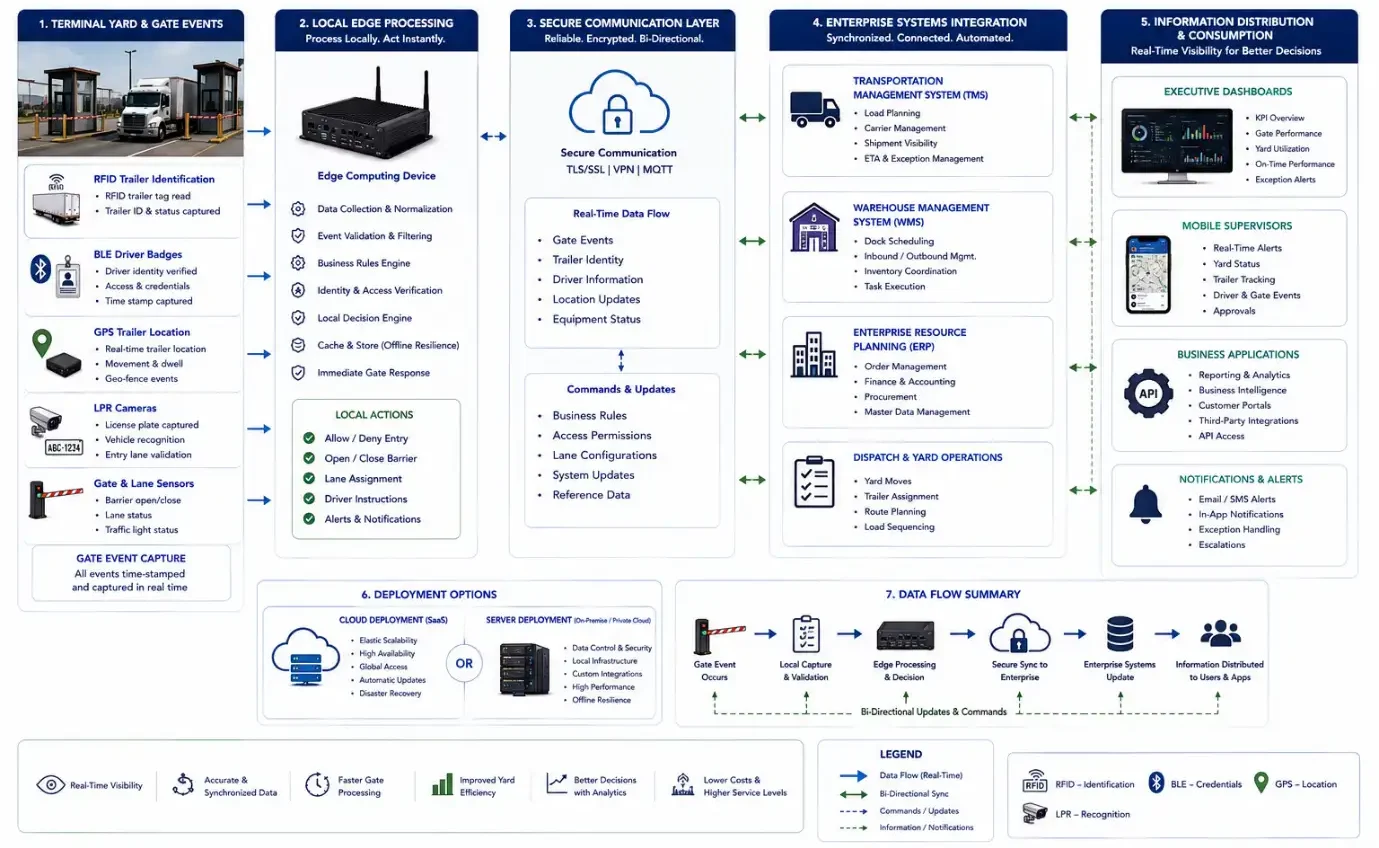
This workflow diagram illustrates how terminal yard gate events are processed in real time using RFID trailer identification, BLE driver badges, GPS trailer location devices, and license plate recognition cameras. It shows local edge computing validating and synchronizing operational data with Transportation Management Systems (TMS), Warehouse Management Systems (WMS), Enterprise Resource Planning (ERP), cloud and server deployments, executive dashboards, and mobile supervisors to maintain synchronized trailer records and enterprise-wide operational visibility.
Interoperability with Enterprise Business Software
Large logistics organizations rarely rely on a single software application. Instead, operations involve multiple specialized systems that must exchange reliable information throughout the trailer lifecycle.
Yard Management AI is designed to support interoperability with a broad range of enterprise applications, enabling verified identification and location data to become part of wider operational workflows.
Common software integrations include:
- Transportation Management Software
- Warehouse Management Software
- Enterprise Resource Planning Software
- Fleet Management Software
- Dispatch Management Software
- Gate Security Software
- Visitor Management Software
- Maintenance Management Software
- Business Analytics Software
- Labor Management Software
- Financial Reporting Systems
- Mobile Workforce Applications
By supporting standardized communication methods and configurable data exchange, organizations can preserve existing software investments while extending operational visibility across gate, yard, warehouse, and transportation activities.
Multi-Site Terminal Yard Network Considerations
Many industrial logistics organizations operate multiple manufacturing plants, regional distribution centers, cross-dock facilities, container yards, and transportation terminals. Each location may have different gate layouts, operating procedures, carrier requirements, and local infrastructure, yet corporate logistics teams still require a unified operational view.
AI and IoT integration enables standardized identification, location tracking, and data synchronization across geographically dispersed yard operations while allowing each facility to maintain its own operational workflows.
Standardized Data Across Facilities
A common integration strategy helps ensure that trailer identification, gate events, yard inventory, and movement records follow consistent business rules regardless of location.
Enterprise benefits include:
- Consistent trailer identification procedures
- Unified gate transaction records
- Standardized carrier verification
- Shared asset identification policies
- Consolidated operational reporting
- Centralized audit trails
- Common user access policies
- Enterprise-wide operational visibility
This consistency simplifies corporate reporting while supporting local operational flexibility.
Regional and Enterprise Reporting
When multiple facilities exchange standardized operational data, organizations gain a broader understanding of logistics performance across their entire network.
Examples of enterprise reporting include:
- Trailer utilization across facilities
- Average gate processing times
- Carrier turnaround comparisons
- Yard occupancy by location
- Empty trailer availability
- Loaded trailer distribution
- Dock utilization trends
- Multi-site dwell time analysis
- Asset movement history
- Regional logistics performance
These reports assist transportation managers, warehouse directors, and supply chain leadership in identifying operational improvement opportunities using verified operational data rather than manual reporting.
Cybersecurity and Data Governance Considerations
System integration within terminal yard operations must maintain strong cybersecurity practices while protecting operational continuity. Since gate systems exchange information with transportation, warehouse, and enterprise applications, secure communication and controlled access are essential.
Key cybersecurity considerations include:
- Encrypted communications using TLS and HTTPS
- Secure API authentication
- Role-based user permissions
- Multi-factor authentication where applicable
- Network segmentation between operational and enterprise systems
- Secure VPN connectivity for remote access
- Comprehensive audit logging
- Controlled software update procedures
- Backup and disaster recovery planning
- Compliance with corporate cybersecurity policies
Organizations should also establish clear data governance policies defining data ownership, retention periods, user privileges, and synchronization rules to ensure operational integrity across multiple facilities.
Hardware and Software Integration Best Practices
Successful AI and IoT integration projects begin with a clear understanding of existing operational processes and enterprise software environments. Careful planning helps reduce implementation risks while supporting long-term scalability.
Recommended best practices include:
- Assess existing TMS, WMS, ERP, and security software
- Define standardized trailer and driver identification methods
- Map gate event workflows before deployment
- Use open communication protocols and documented APIs
- Validate data synchronization between all connected systems
- Plan for offline operation and automatic recovery
- Establish cybersecurity and user access policies
- Perform pilot testing before full deployment
- Train operational and IT personnel on integrated workflows
- Continuously monitor system performance and data quality
Following these practices supports reliable identification, location tracking, and enterprise data exchange throughout the terminal yard.
Why Organizations Choose Yard Management AI
Yard Management AI develops enterprise AI and IoT integration solutions specifically for industrial logistics and supply chain environments where reliable identification and location tracking are critical to operational efficiency. Our solutions are designed to connect gate operations, trailer movements, warehouse activities, and transportation workflows using secure, standards-based integration methods.
Created within Aperture Venture Studio with support from GAO, Yard Management AI builds on more than two decades of IoT experience gained through thousands of successful deployments across industrial logistics environments. Drawing on practical knowledge from GAO and real customer implementations, we have invested extensively in research and development, rigorous quality assurance processes, and expert technical support delivered both remotely and onsite.
Our engineering organization is led by Ph.D. professionals from leading universities and is strengthened by strategic investments, experienced technical specialists, and industry partnerships. Over the years, our teams have supported Fortune 500 manufacturers, logistics providers, research institutions, universities, and government agencies throughout the United States and Canada with enterprise AI and IoT identification and location solutions.
Whether an organization is integrating gate access systems, trailer tracking software, warehouse operations, or enterprise resource planning systems, our focus remains on delivering dependable, scalable, and interoperable solutions that align with operational objectives and long-term digital transformation strategies.
Advancing Connected Terminal Yard Operations with AI and IoT
Modern yard management depends on the seamless exchange of verified operational information between gate operations, trailer locations, warehouse execution, transportation planning, and enterprise business software. AI and IoT integration transforms isolated identification events into synchronized operational data that supports faster decision-making, improved asset visibility, reduced manual processes, and greater operational consistency across terminal yard networks.
By combining standardized integration methods, flexible deployment models, edge processing for gate events, and real-time data synchronization, organizations can connect trailer yards with TMS, WMS, ERP, and other enterprise systems while maintaining security, scalability, and business continuity. Yard Management AI provides the technical expertise, implementation experience, and enterprise-grade solutions needed to help industrial logistics organizations modernize gate and yard operations through reliable AI and IoT integration.