
AI-Enabled Trailer Yard Operations for Enterprise Distribution Centers
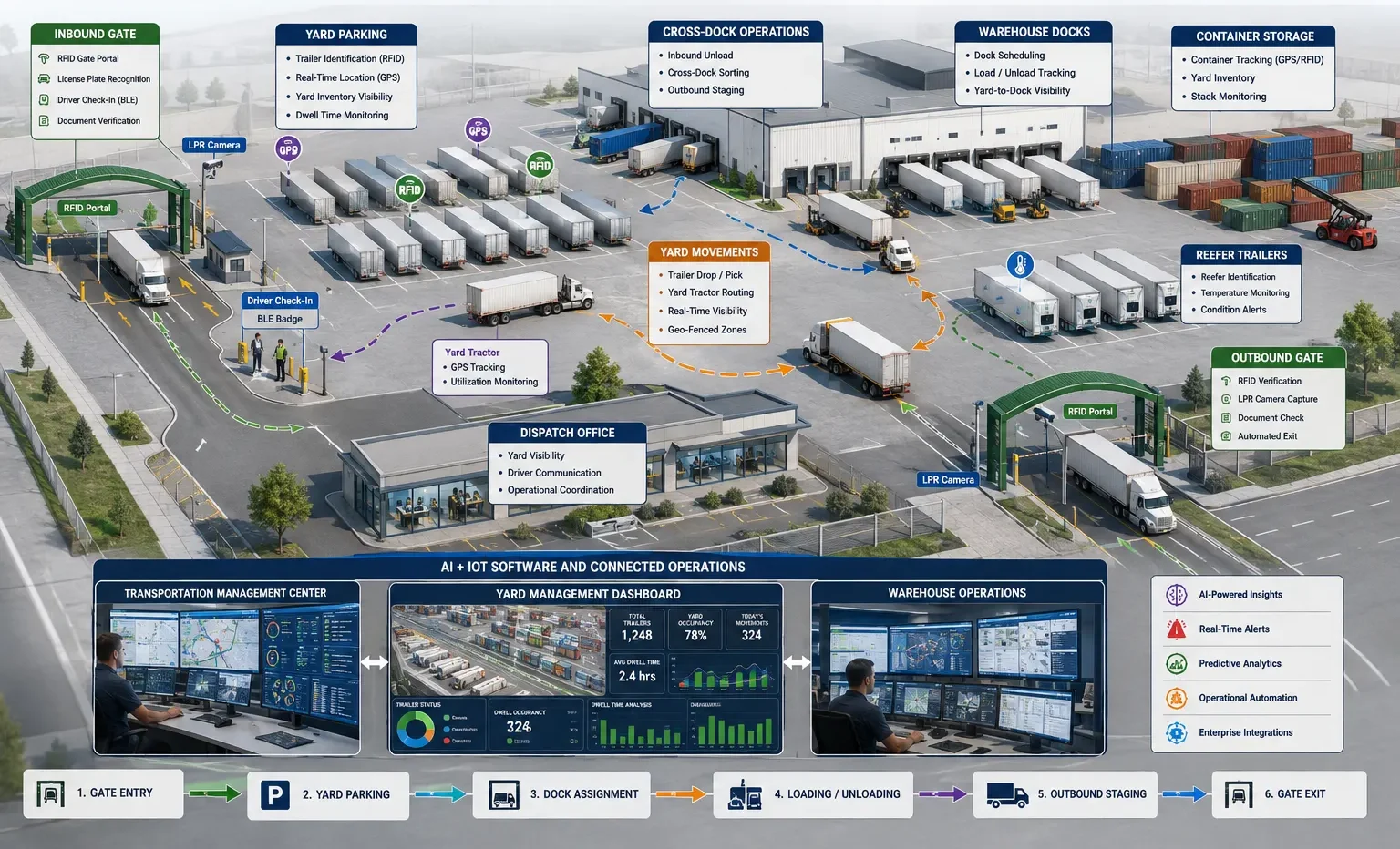
This illustration presents a complete AI + IoT-enabled trailer yard supporting enterprise logistics operations. It shows how gate automation, trailer identification, yard movements, dock assignments, warehouse operations, and dispatch coordination work together to improve trailer visibility, operational efficiency, and yard management.
AI Functions for AIoT-Enabled Trailer Yard Operations
Trailer yards operate as dynamic logistics environments where assets constantly arrive, depart, relocate, and wait for dock assignments. Maintaining accurate visibility across these activities requires more than periodic inspections. AI and IoT combines machine learning, Edge AI, computer vision, RFID identification, BLE location services, GPS positioning, cellular communications, and connected industrial systems to automate operational awareness while reducing manual intervention.
Unlike warehouse inventory systems that primarily focus on indoor storage, trailer yard operations require continuous visibility across moving assets, gate traffic, outdoor parking zones, hostler operations, and transportation scheduling. Identification and location technologies provide the operational foundation needed for faster trailer movements and improved utilization.
The most valuable capabilities include:
- Automated gate processing
- Driver identification
- Trailer identification
- Real-time trailer location
- Yard inventory visibility
- Trailer utilization analysis
- Shipment progression visibility
- Yard movement optimization
- Cross-dock coordination
- Multi-site yard visibility
These capabilities help reduce trailer search times, improve dock scheduling accuracy, minimize detention charges, and provide transportation planners with reliable operational information.
Intelligent Gate Operations and Driver Verification
Every trailer movement begins and ends at the gate. Delays during entry or exit create congestion throughout the yard while affecting warehouse scheduling and transportation performance.
AI and IoT automates gate processing by identifying arriving vehicles, validating authorized drivers, confirming trailer assignments, recording arrival times, and synchronizing gate events with transportation and warehouse software. Computer vision, RFID, BLE credentials, license plate recognition, and secure identity verification work together to reduce manual processing while improving operational consistency.
Typical operational improvements include:
- Faster driver check-in
- Reduced gate congestion
- Improved visitor management
- Automated arrival documentation
- Trailer assignment validation
- Digital gate event history
- Enhanced security auditing
- Accurate carrier verification
Facilities handling hundreds of daily truck arrivals benefit from standardized gate procedures that reduce administrative workload while improving throughput.
Real-Time Trailer Visibility Throughout the Yard
Locating trailers quickly remains one of the largest operational challenges within busy distribution campuses.
Manual yard checks consume labor, delay dock assignments, and increase the likelihood of misplaced trailers. AI and IoT continuously associates trailer identities with their current yard positions, allowing dispatchers and yard coordinators to locate assets without conducting physical searches.
Real-time trailer visibility supports:
- Empty trailer management
- Loaded trailer identification
- Outbound staging
- Inbound receiving coordination
- Trailer pool management
- Drop-and-hook operations
- Yard tractor dispatching
- Dock door scheduling
Accurate trailer visibility helps warehouse managers prepare receiving activities while transportation teams coordinate carrier arrivals more effectively.
Yard Inventory Accuracy
Trailer inventory changes continuously as carriers arrive, trailers move between parking zones, shipments are loaded, and outbound equipment departs.
Automated identification significantly improves yard inventory accuracy by continuously validating trailer presence, movement history, parking locations, and operational status.
Operational advantages include:
- Reduced manual yard audits
- Faster trailer reconciliation
- Improved dock scheduling
- Better trailer utilization
- Reduced misplaced equipment
- Improved detention tracking
- Accurate fleet availability
- Improved carrier collaboration
Reliable yard inventory also improves transportation planning, helping dispatch teams assign trailers based on actual availability rather than outdated records.
Yard Performance Analytics
Operational visibility extends beyond knowing where trailers are located. Historical movement information provides valuable insights into how efficiently the yard operates.
AI analyzes operational events including:
- Trailer dwell time
- Average gate processing duration
- Carrier turnaround performance
- Yard congestion patterns
- Dock utilization
- Yard truck productivity
- Parking zone utilization
- Peak arrival periods
These operational metrics help logistics managers identify bottlenecks, improve labor allocation, optimize trailer flow, and reduce unnecessary trailer movements throughout the facility.
Rather than relying solely on periodic reports, managers receive continuously updated operational information that supports better day-to-day decision making.
AI + IoT Workflow for Enterprise Trailer Yard Operations
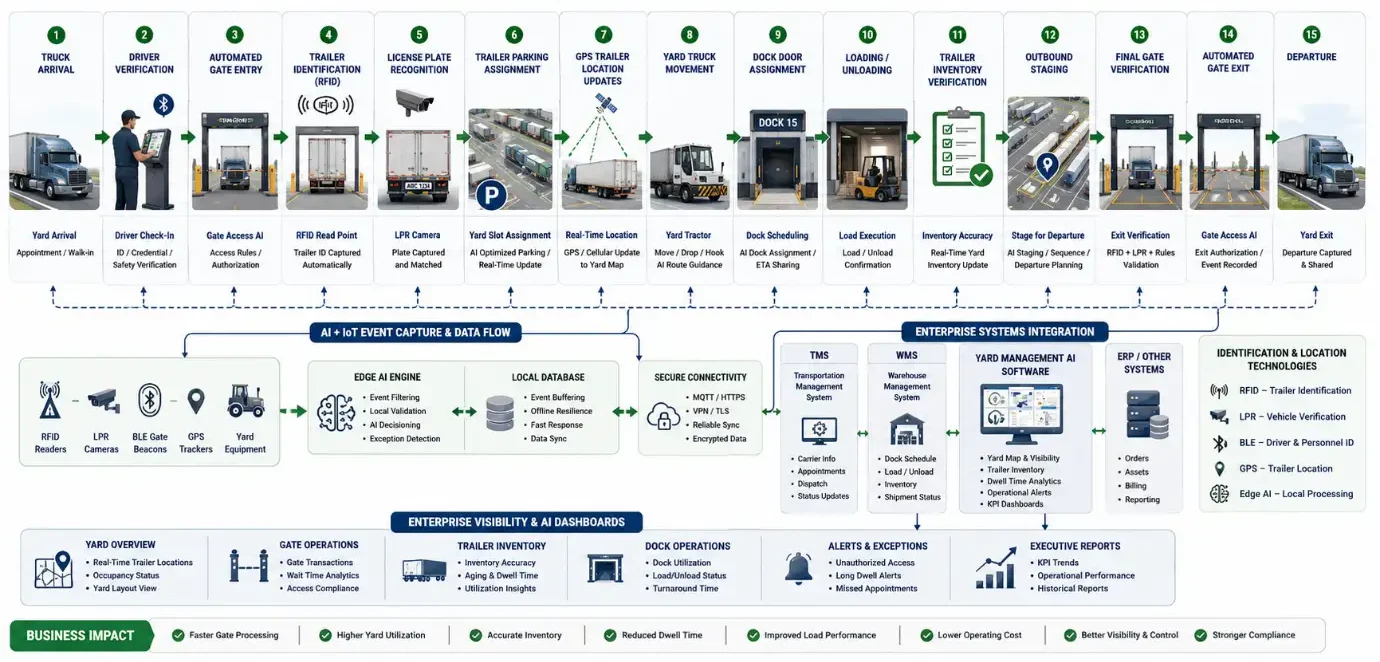
This workflow diagram illustrates the complete operational lifecycle of a modern AI + IoT-enabled trailer yard. It demonstrates how RFID, BLE, GPS, license plate recognition, Edge AI, TMS, WMS, and enterprise dashboards work together to automate gate processing, improve trailer visibility, optimize yard movements, and support real-time logistics operations.
IoT Software for AIoT-Enabled Distribution Yard Sites
Efficient trailer yard operations depend on more than identification devices installed at gates or trailers. Operational value is created when gate events, trailer locations, driver activities, and shipment movements are organized into software that supports dispatchers, transportation planners, warehouse supervisors, security personnel, and logistics managers.
Yard Management AI develops AI and IoT software specifically for trailer yards, distribution campuses, cross-dock facilities, intermodal terminals, and industrial logistics operations. The software focuses on identification, location, operational coordination, and event management rather than generic enterprise applications.
Designed for high-volume freight environments, the software helps organizations reduce manual data entry while improving operational visibility across inbound and outbound transportation activities.
Gate Access Control Software
Gate operations represent one of the busiest operational areas within any logistics yard. Every arriving truck, trailer, contractor, visitor, or carrier must be authenticated before entering operational areas.
The Gate Access Control Software automates this process by validating identities, recording gate transactions, and coordinating access with transportation schedules.
Key capabilities include:
- Automated gate entry and exit processing
- Driver identity verification
- Carrier authorization validation
- Trailer assignment confirmation
- License plate recognition integration
- RFID credential management
- Visitor registration
- Digital gate transaction history
- Security audit reporting
- Real-time gate status monitoring
The software reduces manual gate processing while helping security teams maintain consistent operational procedures during peak traffic periods.
Driver Credential Management Software
Modern distribution centers often receive hundreds of drivers every day from multiple transportation providers.
Driver Credential Management Software centralizes the verification of:
- Commercial driver credentials
- Carrier information
- Scheduled appointments
- Safety compliance records
- Facility access permissions
- Temporary visitor access
- Contractor authorization
- Digital identification records
Authorized personnel move through gate processing more efficiently while maintaining documented verification procedures for compliance and operational auditing.
Trailer Location Software
Finding a specific trailer should never require searching hundreds of parking spaces.
Trailer Location Software continuously maintains the operational location of trailers throughout the yard using identification technologies including:
- RFID
- GPS
- BLE
- License plate recognition
- Cellular communication
Operations teams can quickly locate:
- Empty trailers
- Loaded trailers
- Inbound trailers
- Outbound trailers
- Damaged trailers
- Quarantined trailers
- Priority shipments
- Assigned dock trailers
Transportation planners, yard coordinators, and warehouse personnel all work from the same continuously updated operational information.
Yard Inventory Management Software
Trailer inventory changes every minute as vehicles arrive, move between parking areas, reach loading docks, or leave the facility.
Rather than depending on manual yard checks, the software automatically maintains an operational record of:
- Trailer inventory
- Parking locations
- Yard zones
- Dock assignments
- Available equipment
- Reserved trailers
- Carrier assets
- Trailer pools
Operational dashboards allow managers to evaluate overall yard utilization while identifying unused capacity or congestion before delays begin affecting warehouse productivity.
Load Status Tracking Software
Shipments often progress through multiple operational stages before departing a facility.
Load Status Tracking Software records operational milestones such as:
- Arrival
- Check-in
- Inspection
- Dock assignment
- Loading
- Load completion
- Documentation verification
- Release authorization
- Departure
This chronological visibility helps warehouse personnel coordinate labor while transportation planners receive timely updates regarding shipment readiness.
Reefer Monitoring Software
Distribution yards supporting food distribution, pharmaceutical logistics, grocery networks, and temperature-controlled transportation frequently manage refrigerated trailers alongside dry freight.
The Reefer Monitoring Software maintains operational awareness of refrigerated trailer activities by recording:
- Reefer trailer identification
- Arrival history
- Parking location
- Dock assignment
- Departure scheduling
- Fleet visibility
Combined with cellular communications, organizations maintain better operational coordination across temperature-controlled trailer fleets without interrupting normal yard activities.
AI + IoT Software Solution for Intelligent Trailer Yard Operations
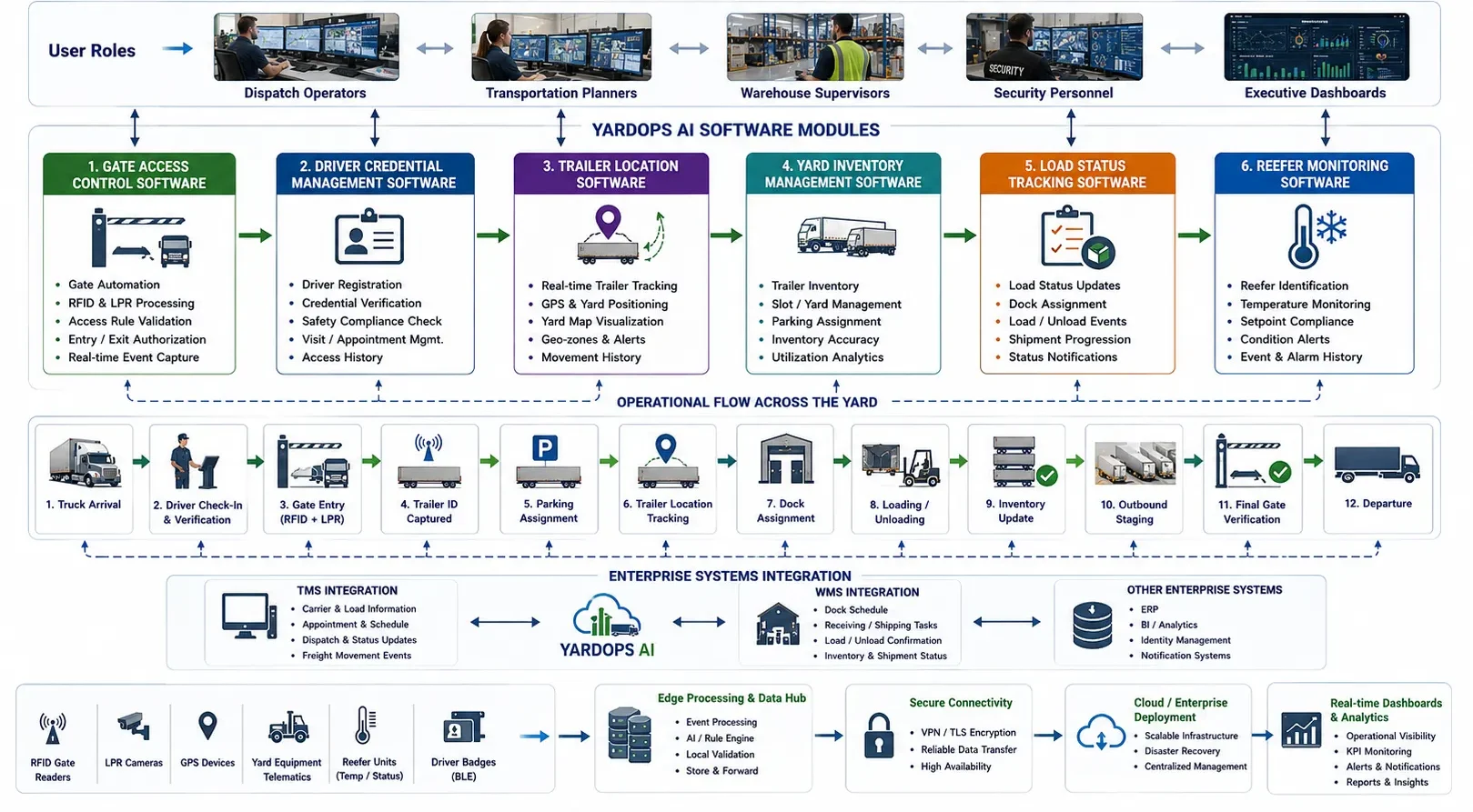
This diagram shows how AI + IoT software modules coordinate trailer yard operations from gate entry through outbound departure. It highlights integration between gate access, trailer location, yard inventory, load tracking, reefer monitoring, TMS, WMS, and enterprise dashboards to improve operational visibility and workflow efficiency.
Hardware Technologies for AIoT-Enabled Gate and Yard Logistics
Reliable yard visibility begins with dependable identification and location technologies. Trailer yards present unique operational challenges because equipment is constantly moving across large outdoor areas exposed to weather, heavy vehicle traffic, and continuous operational activity.
Yard Management AI supports hardware technologies that emphasize identification, authentication, and location awareness while integrating directly with enterprise logistics software. The solutions are suitable for distribution centers, manufacturing shipping yards, cross-dock terminals, intermodal facilities, and container yards where operational continuity is essential.
Yard Identification Devices
Several complementary technologies work together to maintain continuous operational awareness throughout the yard.
Common identification devices include:
- RFID trailer tags
- BLE gate beacons
- GPS trailer trackers
- GPS yard truck trackers
- License Plate Recognition (LPR) cameras
- RFID gate portals
- Driver identification badges
- Vehicle-mounted readers
Each technology serves a specific purpose, allowing organizations to select the most appropriate combination based on facility size, operational workflow, and transportation requirements.
AI and RFID for Trailer Identification
RFID remains one of the most effective technologies for automatically identifying trailers entering and leaving logistics facilities.
RFID enables:
- Automated trailer recognition
- Gate verification
- Trailer inventory automation
- Trailer movement history
- Dock assignment confirmation
- Trailer pool management
- Carrier asset identification
RFID gate read points reduce manual identification while improving the accuracy of operational records across busy distribution yards.
AI and BLE for Driver and Proximity Identification
Bluetooth Low Energy supports personnel identification and proximity-based operational workflows.
Typical BLE applications include:
- Driver badges
- Authorized personnel verification
- Vehicle proximity recognition
- Restricted area access
- Yard worker identification
- Mobile workforce coordination
BLE complements RFID by providing flexible identification for personnel and mobile assets operating throughout the facility.
AI and GPS for Yard Visibility
GPS technology provides continuous location awareness across large outdoor logistics environments.
GPS supports:
- Trailer positioning
- Yard tractor tracking
- Fleet movement visibility
- Remote trailer management
- Trailer relocation verification
- Multi-yard operational visibility
Organizations operating multiple distribution campuses can coordinate trailer movements using consistent location information across geographically separated facilities.
AI and Cellular Communications
Cellular connectivity enables operational communication between remote trailers and centralized logistics software.
Cellular communications support:
- Trailer connectivity
- GPS reporting
- Reefer fleet communication
- Fleet-wide operational updates
- Remote asset visibility
- Multi-site logistics coordination
This communication capability becomes particularly valuable for organizations managing trailers beyond individual distribution yards.
Selecting the Right Identification Technologies
Most trailer yards benefit from combining multiple identification methods rather than relying on a single technology.
Selection depends on several operational considerations:
- Facility size
- Trailer volume
- Carrier diversity
- Security requirements
- Existing transportation software
- Warehouse integration requirements
- Yard traffic density
- Expansion plans
Many organizations implement RFID at gate entry points, GPS for trailer positioning, BLE for personnel identification, and LPR cameras for vehicle verification to create comprehensive yard visibility while maintaining operational flexibility.
AI + IoT Identification and Location Solution for Trailer Yard Operations
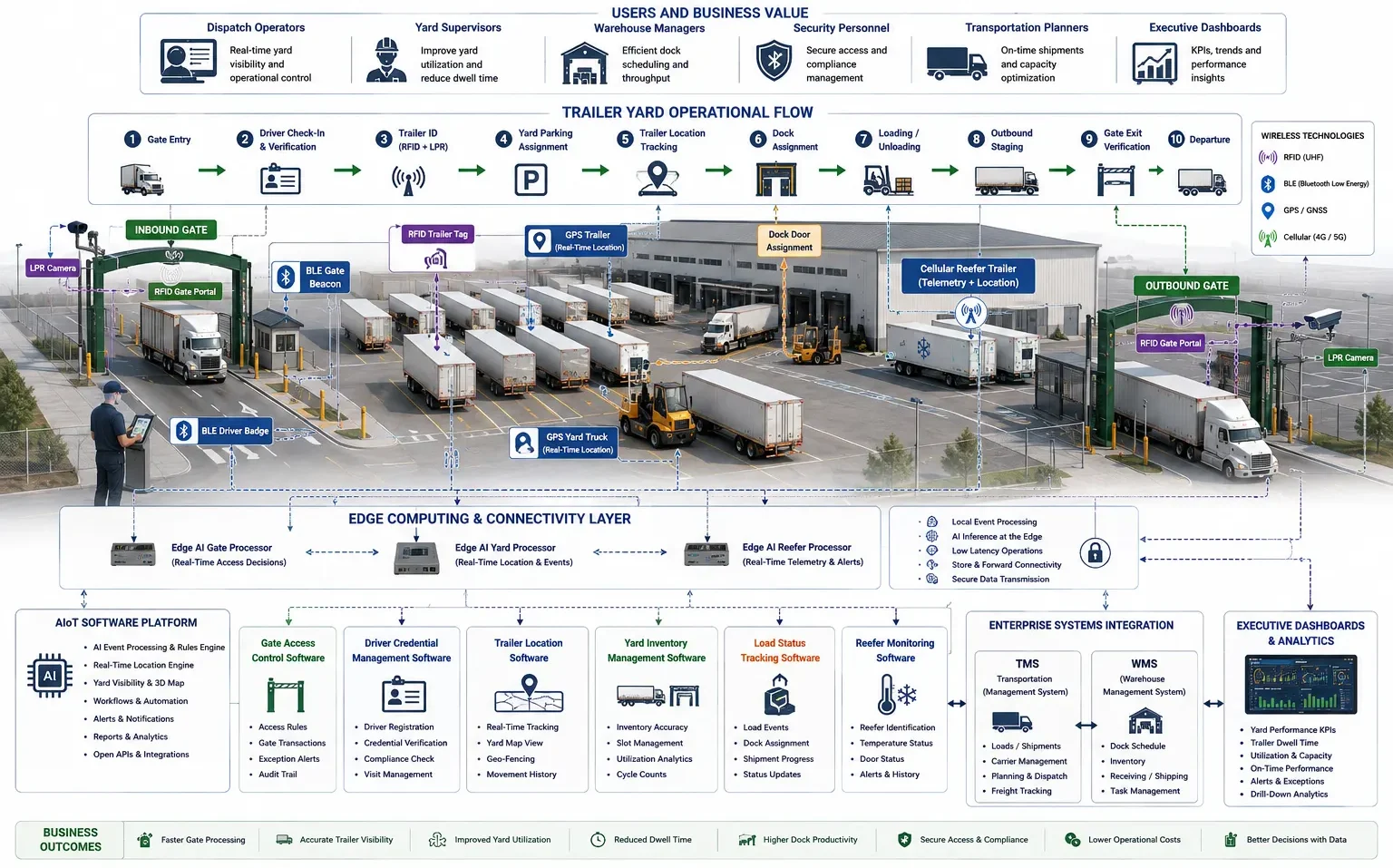
This enterprise solution diagram illustrates how RFID, BLE, GPS, cellular connectivity, license plate recognition, edge computing, AI software, TMS, and WMS work together to support trailer identification, gate processing, yard visibility, dock assignment, and outbound logistics. It demonstrates end-to-end trailer movement and enterprise data flow across a modern distribution yard.
Integration for AIoT-Enabled Terminal Yard Operations
Trailer yards operate at the intersection of transportation, warehouse, security, and logistics workflows. Identifying trailers or automating gate events delivers greater value when operational data is synchronized with existing business systems. Yard Management AI supports enterprise integration that enables trailer movements, gate transactions, and yard inventory updates to flow into transportation and warehouse operations with minimal manual intervention.
The software is designed to complement existing logistics investments rather than replace them. Organizations can continue using their preferred transportation, warehouse, and business applications while extending operational visibility to the yard.
TMS Integration for Yards
Transportation Management Systems (TMS) coordinate carrier appointments, route planning, freight movement, and shipment execution. Integrating yard operations with the TMS allows dispatchers and transportation planners to monitor trailer movements without switching between multiple applications.
Typical integration capabilities include:
- Carrier appointment synchronization
- Arrival and departure event updates
- Trailer assignment verification
- Dock scheduling coordination
- Carrier performance reporting
- Trailer dwell time analysis
- Shipment readiness notifications
- Outbound dispatch confirmation
Transportation teams gain accurate operational data that supports improved scheduling, reduced detention costs, and better carrier collaboration.
WMS Integration for Yards
Warehouse Management Systems (WMS) depend on accurate trailer information to coordinate receiving, shipping, and dock operations. Real-time communication between yard operations and the warehouse reduces delays caused by misplaced trailers or incomplete arrival information.
Integrated workflows support:
- Dock door assignment updates
- Inbound receiving preparation
- Outbound shipment staging
- Trailer arrival confirmation
- Yard inventory synchronization
- Shipping status updates
- Trailer release authorization
- Warehouse labor planning
Warehouse supervisors can prepare dock activities using current trailer locations rather than relying on manual phone calls or yard inspections.
Cloud and Server Deployment Options
Every logistics organization has different operational, cybersecurity, and compliance requirements. Yard Management AI offers deployment options that align with existing IT strategies while supporting future expansion.
Cloud Yard Management Software
Cloud deployment is suitable for organizations that require centralized access across multiple facilities.
Benefits include:
- Multi-site operational visibility
- Centralized administration
- Remote access for authorized users
- Simplified software updates
- Enterprise scalability
- Consolidated reporting
This approach is commonly selected by logistics providers, retail distribution networks, and organizations managing geographically dispersed trailer yards.
Server-Based Yard Management Software
Server-based deployment is appropriate for organizations that prefer to maintain operational data within their own infrastructure.
Advantages include:
- Local data control
- Support for internal security policies
- Integration with existing IT environments
- Operational continuity in restricted networks
- Custom deployment configurations
Facilities operating under strict cybersecurity or regulatory requirements often choose server-based implementations.
Edge Processing for Gate Events
Busy distribution centers cannot afford delays while waiting for operational decisions. Processing selected gate events locally improves responsiveness during high-volume traffic periods.
Edge processing supports activities such as:
- Driver credential validation
- Trailer identification
- License plate recognition
- Gate authorization
- Entry and exit event processing
- Temporary communication resilience
Only the required operational information is synchronized with enterprise software, helping maintain efficient gate throughput.
Real-Time Data Synchronization
Operational decisions become more reliable when all departments work from the same information.
Real-time synchronization distributes updates related to:
- Trailer locations
- Gate events
- Driver verification
- Dock assignments
- Yard inventory
- Shipment progression
- Carrier arrivals
- Departure confirmations
Operations personnel, warehouse teams, transportation planners, and management can view consistent information, reducing communication delays and manual reconciliation.
Enterprise Integration for AIoT-Enabled Terminal Yard Operations
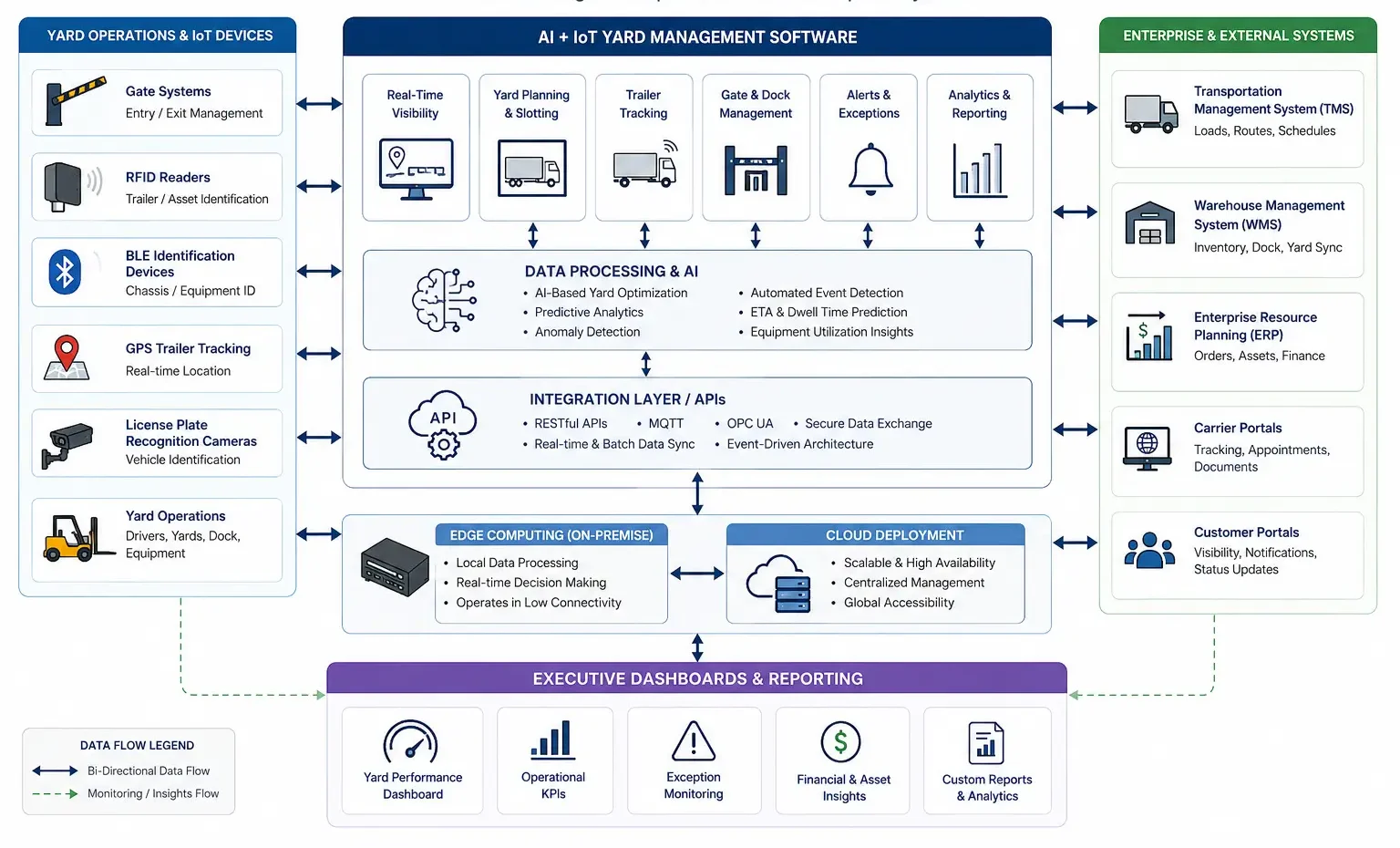
This enterprise integration diagram demonstrates how AI and IoT-enabled terminal yard management software exchanges data with transportation, warehouse, and enterprise business systems. It illustrates bi-directional integration between TMS, WMS, ERP, carrier portals, edge computing devices, cloud and on-premises deployments, RFID, BLE, GPS tracking, license plate recognition, gate systems, executive dashboards, and daily yard operations to enable real-time visibility, automation, and operational efficiency across terminal logistics.
Cross-Dock, Cold Chain, and Container Yard Applications
Every yard has unique operational requirements based on freight type, facility layout, carrier activity, and shipment priorities. Yard Management AI supports a wide range of industrial logistics environments by emphasizing identification, location awareness, and operational coordination.
Cross-Dock Yard Operations
Cross-dock facilities depend on rapid trailer turnover to minimize storage time and accelerate freight movement. Accurate trailer identification and gate processing help ensure inbound freight is transferred efficiently to outbound transportation.
AI and IoT supports cross-dock operations by improving:
- Trailer sequencing
- Dock assignment accuracy
- Driver processing
- Trailer location
- Shipment progression
- Outbound readiness
These capabilities reduce congestion while improving throughput during peak operating hours.
Distribution Center Yard Management
Large distribution centers often manage hundreds of trailers across multiple parking zones and loading docks. Coordinating these assets manually becomes increasingly difficult as freight volume grows.
Operational improvements include:
- Faster trailer retrieval
- Improved dock utilization
- Accurate trailer inventory
- Reduced search time
- Better yard truck dispatching
- Carrier turnaround visibility
Continuous identification and location awareness help maintain efficient yard operations while supporting warehouse productivity.
Cold Chain Yard Operations
Facilities handling refrigerated freight require accurate visibility of reefer trailers throughout the yard. Coordinating trailer movements helps maintain shipment schedules and supports efficient loading and unloading activities.
Typical applications include:
- Refrigerated trailer identification
- Reefer parking management
- Dock scheduling
- Cold chain shipment visibility
- Trailer departure coordination
- Fleet utilization reporting
These capabilities assist food distribution, pharmaceutical logistics, and other temperature-controlled transportation operations.
Container Yard Operations
Container terminals and intermodal facilities manage containers arriving from rail, ports, and trucking operations. Maintaining visibility across container locations improves operational efficiency and equipment utilization.
Supported activities include:
- Container identification
- Yard block management
- Container location
- Equipment utilization
- Gate verification
- Container movement history
Organizations can coordinate container handling while maintaining accurate operational records.
Multi-Site Yard Visibility
Organizations operating several logistics facilities benefit from centralized operational oversight.
Multi-site visibility provides:
- Unified trailer inventory
- Fleet utilization reporting
- Standardized gate procedures
- Consolidated operational dashboards
- Cross-site trailer movement history
- Enterprise reporting
Managers gain a comprehensive view of operations across regional distribution networks without sacrificing local operational control.
AIoT Workflow Across Trailer Yard Environments
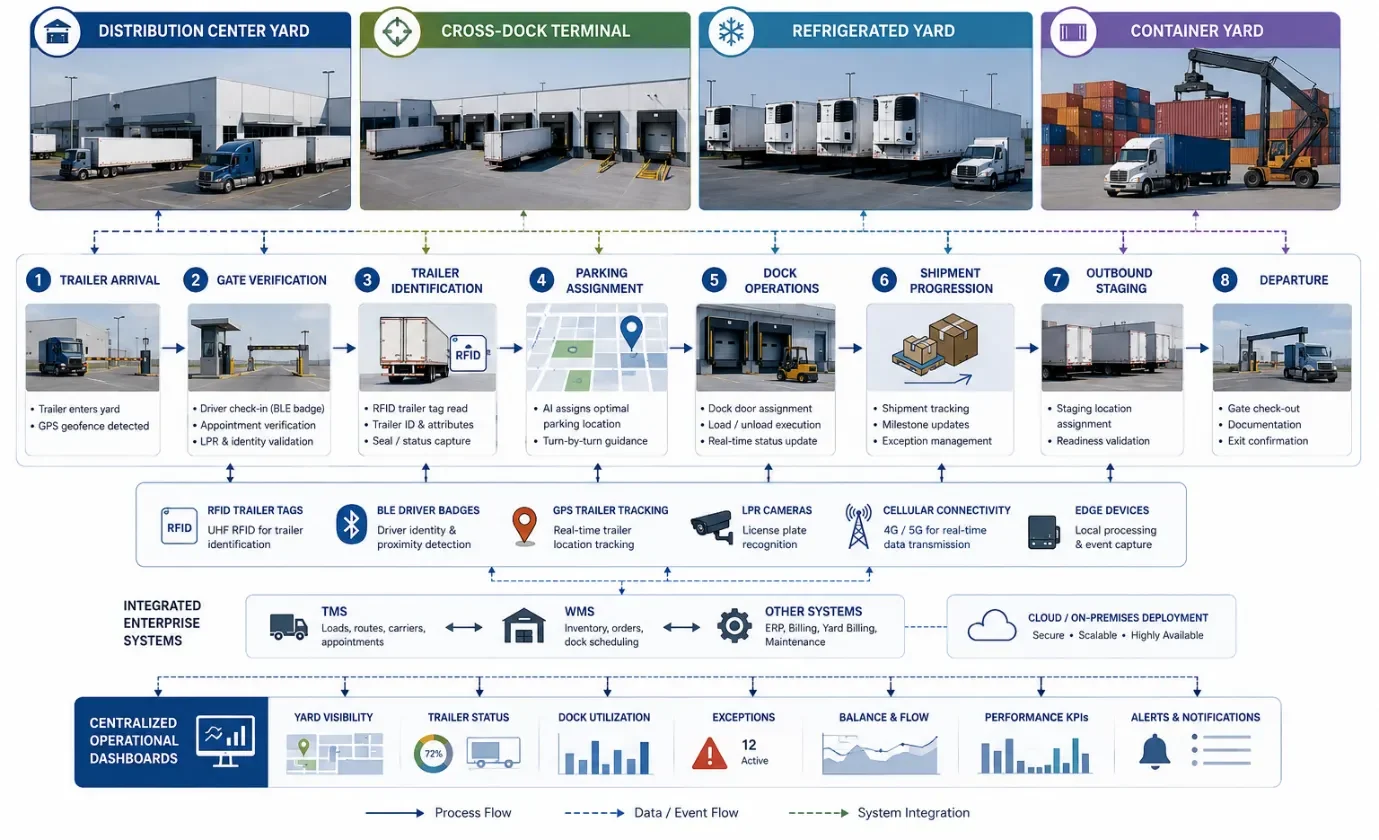
This workflow diagram illustrates how AI and IoT streamline operations across distribution center yards, cross-dock terminals, refrigerated yards, and container yards. It follows the operational flow from trailer arrival and gate verification through identification, parking assignment, dock operations, shipment progression, outbound staging, and departure while integrating RFID, BLE, GPS tracking, TMS, WMS, cellular connectivity, and centralized operational dashboards for real-time visibility and coordination.
Knowledge Center for Trailer and Gate Logistics Operations
Successful AI and IoT deployments require more than hardware and software. Organizations also need practical guidance, technical documentation, and implementation resources that support planning, deployment, integration, and long-term operational success.
The Knowledge Center provides resources developed for logistics professionals, transportation managers, warehouse leaders, IT teams, and system integrators.
Available resources include:
- Yard management documentation
- AI and IoT deployment guides
- RFID implementation references
- BLE identification best practices
- GPS tracking guidance
- Integration documentation
- Technical FAQs
- Operational workflow examples
- Industry use cases
- System configuration recommendations
These materials help organizations evaluate technologies, plan phased deployments, and improve operational outcomes.
About Yard Management AI
Yard Management AI delivers enterprise AI and IoT solutions focused on trailer yard visibility, gate operations, trailer identification, and logistics coordination for industrial supply chain operations.
The company was created within Aperture Venture Studio with support from GAO. Drawing on more than two decades of IoT experience, the team has contributed to thousands of successful IoT projects serving organizations across industrial logistics, transportation, manufacturing, and distribution. This experience has guided substantial investment in research and development, rigorous quality assurance practices, and expert technical support delivered remotely and on-site.
The organization is led by Ph.D. professionals and supported by experienced engineers, solution architects, and strategic partners. Its experience includes supporting Fortune 500 companies, leading research institutions, prestigious universities, and government organizations throughout the United States and Canada.
The goal is to provide technically sound AI and IoT solutions that improve operational visibility, simplify deployment, and deliver measurable value for trailer yard operations.
Contact Us
Whether your organization is modernizing a single distribution yard or coordinating multiple logistics facilities, our technical specialists can help evaluate the appropriate AI and IoT identification and location technologies for your operational requirements.
Our team can assist with:
- Operational assessments
- Technology selection
- Pilot project planning
- Enterprise software integration
- Deployment strategy
- Technical documentation
- Remote technical support
- On-site implementation assistance
Contact Yard Management AI to discuss how AI and IoT can improve trailer visibility, gate efficiency, yard inventory accuracy, and operational coordination across your logistics network.
Transforming Trailer Yard Operations with AI and IoT
Modern trailer yard operations require accurate identification, reliable location awareness, and efficient coordination between transportation and warehouse activities. AI and IoT provides the tools needed to automate gate processing, improve trailer visibility, optimize yard inventory, and support informed operational decisions.
By combining identification technologies such as RFID, BLE, GPS, cellular communications, and license plate recognition with enterprise software integration, Yard Management AI helps logistics organizations reduce manual processes, improve trailer utilization, and maintain real-time visibility across every gate, trailer, and yard movement.